







High Strength After H900
A standard H900 age pushes typical tensile strength to about 1340 MPa with yield around 1240 MPa, so thin sections can still carry serious load.

17-4 PH is a martensitic precipitation-hardening stainless steel that combines high strength and good corrosion resistance. The powder chemistry matches ASTM A564 (UNS S17400). To reach full hardness and repeatable mechanical properties, parts are typically solution annealed and then aged.
Want these specifications on hand? Download the full 17-4 PH datasheet as a PDF to share with your team or attach to a drawing package.
Download Datasheet (PDF)17-4 PH gets its name from its 17% chromium and 4% nickel balance. It is one of the alloys we reach for when a part needs stainless corrosion behavior but also has to age harden into the low-40s HRC range.
We treat it as a two-stage material. First we print the geometry, then we run controlled heat treatment to lock in the target condition. The heat-treatment decision matters as much as build orientation for final strength and ductility.
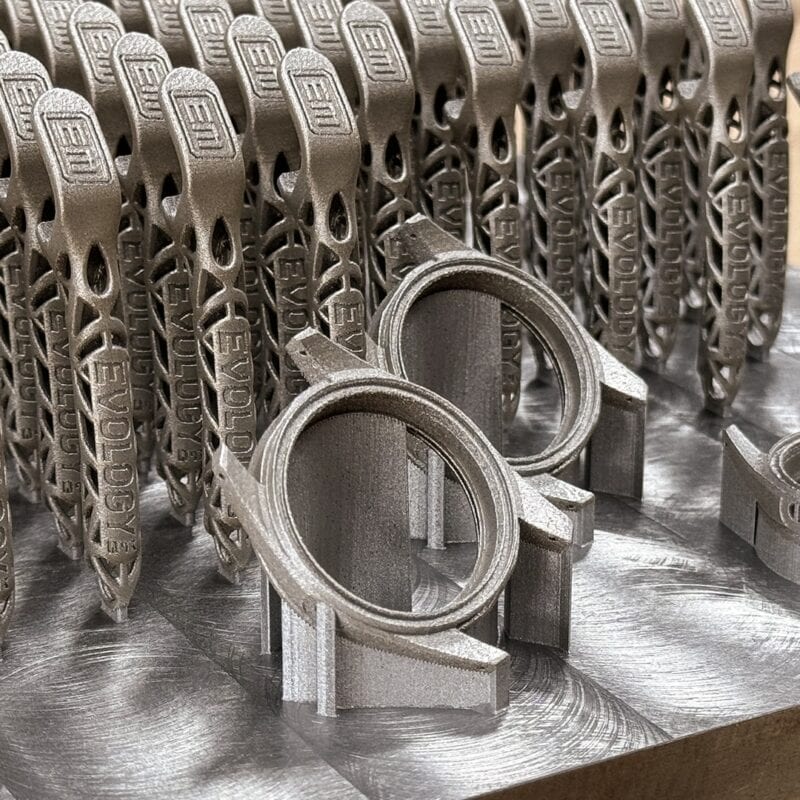
We produce it on our direct metal laser sintering systems and help choose an aging condition that matches your load case, corrosion environment, and post-machining needs.
We reach for 17-4 PH when a part needs more strength than 316L can give without leaving the stainless family for a tool steel.
A standard H900 age pushes typical tensile strength to about 1340 MPa with yield around 1240 MPa, so thin sections can still carry serious load.
17-4 PH resists many service environments better than tool and maraging steels while keeping far higher hardness and strength than 316L.
Moving from H900 to H1150 tunes hardness from roughly 42 HRC down toward 28 HRC, so we balance wear resistance against ductility to suit the part.
The powder chemistry aligns with ASTM A564 (UNS S17400), so teams already specifying wrought or cast 17-4 PH stay in a known material family.
We print 17-4 PH for critical hardware that needs strength, corrosion resistance, and clear heat treatment traceability. Most requests tie back to aviation, defense, and medical programs.
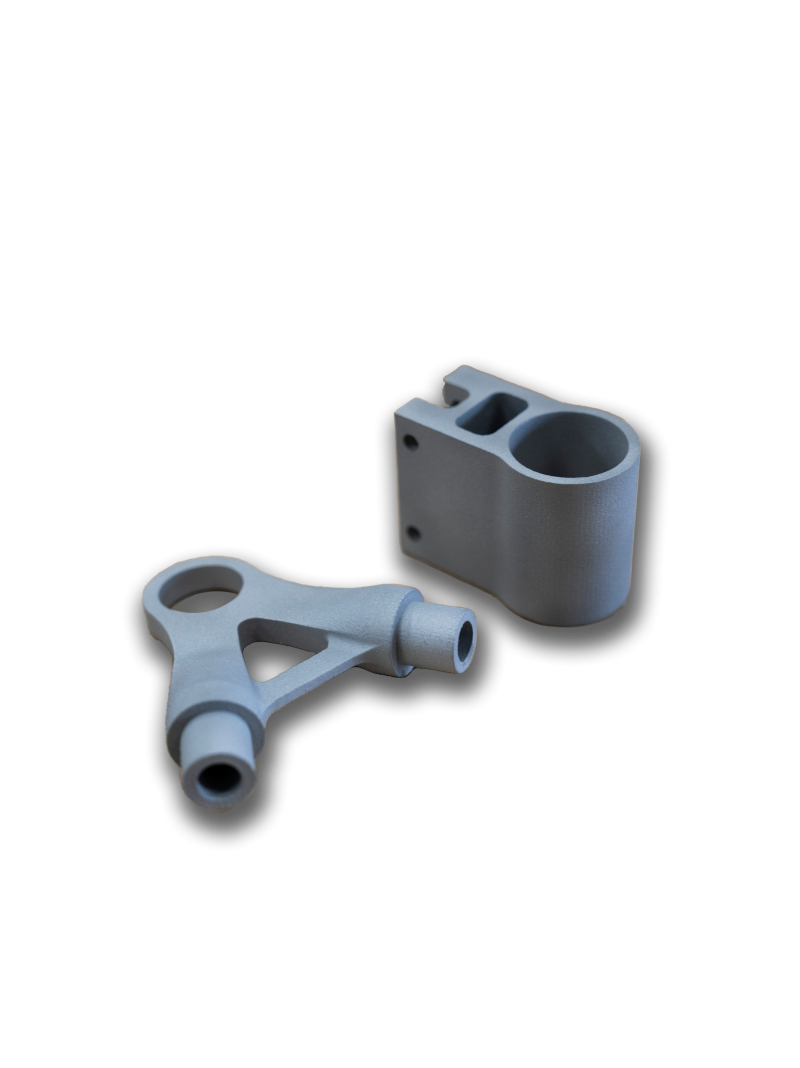
Load-bearing components that need both strength and corrosion resistance, including housings, fixture details, and structural machine elements.
Often selected for reusable instrument hardware where cleanability and high strength matter. We review alloy condition and validation requirements for each program.
Rugged hardware for aircraft and defense systems where high static strength, predictable heat treatment response, and corrosion resistance are all required.
High-strength threaded features, couplers, and shaft-like geometries that benefit from precipitation hardening and DMLS design freedom in one part.
If you are deciding between 17-4 PH, 316L, maraging steel, or Inconel, send us the part and the service conditions. We will recommend the alloy and aging condition that best fits the job.
These values come from the EOS IndustryLine 17-4PH data sheet for M 290 at 40 µm plus EOS published updates for the newer 40/80 µm heat-treated process set. We list orientation and heat-treatment condition explicitly because those choices move the numbers.
| Element | Min. | Max. |
|---|---|---|
| Cr | 15.0 | 17.5 |
| Ni | 3.0 | 5.0 |
| Cu | 3.0 | 5.0 |
| Si | — | 1.0 |
| Mn | — | 1.0 |
| C | — | 0.07 |
| P | — | 0.04 |
| S | — | 0.03 |
| Nb + Ta | 0.15 | 0.45 |
| Fe | Balance | Balance |
| System | Layer thickness | Build rate | Min. wall thickness | Inert gas |
|---|---|---|---|---|
| EOS M 290 | 40 µm | ~3.32 mm³/s | ~0.4 mm | Argon |
| Property | Typical value | Note |
|---|---|---|
| Particle size distribution | ~15–65 µm | D50: 36–44 µm |
| Mean part density | 7.79 g/cm³ | Measured on M 290 40 µm samples |
| Average porosity after heat treatment | 0.030% | Microscopy-based average value |
| Typical shrinkage after heat treatment | ~0.2% | Use for compensation planning |
| Orientation | Yield strength Rp0.2 [MPa] | Tensile strength Rm [MPa] | Elongation at break A [%] | Hardness [HRC] |
|---|---|---|---|---|
| Horizontal | 861 | 886 | 19.9 | 23.9 |
| Vertical | 861 | 924 | 20.1 | — |
| Orientation | Yield strength Rp0.2 [MPa] | Tensile strength Rm [MPa] | Elongation at break A [%] | Hardness [HRC] |
|---|---|---|---|---|
| Horizontal | 1235 | 1336 | 14.0 | 42.1 |
| Vertical | 1251 | 1343 | 13.5 | 42.1 |
| Orientation | Yield strength Rp0.2 [MPa] | Tensile strength Rm [MPa] | Elongation at break A [%] |
|---|---|---|---|
| Horizontal | 1236 | 1340 | 13.5 |
| Vertical | 1243 | 1346 | 12.6 |
Typical hardness after heat treatment is about 42 HRC, with a practical floor around 40 HRC for this condition set.
| Orientation | Yield strength Rp0.2 [MPa] | Tensile strength Rm [MPa] | Elongation at break A [%] |
|---|---|---|---|
| Horizontal | ~1240 | ~1360 | 13–14 |
| Vertical | ~1240 | ~1360 | 13–14 |
| Condition | Ageing cycle | Typical hardness [HRC] |
|---|---|---|
| H900 | 480 °C for 1 h | 42 |
| H925 | 495 °C for 4 h | 38 |
| H1025 | 550 °C for 4 h | 36 |
| H1075 | 580 °C for 4 h | 34 |
| H1100 | 595 °C for 4 h | 32 |
| H1150 | 620 °C for 4 h | 28 |
| Temperature range | CTE |
|---|---|
| 25–100 °C | 10.4 ×10⁻⁶/K |
| 25–200 °C | 11.0 ×10⁻⁶/K |
| 25–300 °C | 11.4 ×10⁻⁶/K |
| 25–400 °C | 11.8 ×10⁻⁶/K |
| 25–500 °C | 12.0 ×10⁻⁶/K |
Need these values in a handoff package? Download the full 17-4 PH datasheet PDF for your design review, sourcing notes, or drawing release.
Download Datasheet (PDF)17-4 PH is usually printed, then aged. The thermal cycle is what takes the alloy from workable as-built condition to high-strength production condition.
Vacuum H900 follows two core steps:
EOS also notes an atmospheric variant that ages at 460 °C for 1 hour, usually in argon, and reports similar high-strength results. We choose vacuum or atmospheric processing based on your specification package and inspection needs.
If your design benefits from lower hardness and more toughness, we can move to H925, H1025, H1075, H1100, or H1150 instead. We also account for the typical ~0.2% dimensional shrinkage after heat treatment when we plan machining stock and critical fits.
17-4 PH is a martensitic precipitation-hardening stainless steel. In DMLS it prints near net shape first, then usually goes through solution anneal and aging to reach its target hardness and strength. The chemistry follows ASTM A564 (UNS S17400), so it is a familiar alloy family for many engineering teams.
17-4 PH generally lands between those two choices. Compared with 316L, it can reach much higher hardness and strength after aging. Compared with maraging steel, it keeps better corrosion resistance while still delivering strong mechanical performance. We usually choose among them based on corrosion exposure, required hardness, and post-processing plan.
In most cases, yes. As-built properties are usable, but precipitation hardening is what gives 17-4 PH its full performance. The common route is solution anneal followed by an aging cycle such as H900. We confirm the exact cycle from the load case, tolerance stack, and any downstream machining or inspection requirements.
H900 is a one-hour age at about 480 °C after solution annealing. It gives the highest hardness (around 42 HRC) and very high strength. If you need more toughness or ductility, higher-temperature aging conditions such as H925 through H1150 can be better, trading some hardness for a less brittle response.
We most often see engineering hardware that needs both strength and corrosion resistance: fasteners, shafts, tooling details, housings, and rugged assemblies for aerospace and defense programs. It is also used for medical and surgical instruments; as with all critical parts, we review the required alloy condition and validation plan before production.
Send us your model and target requirements. We will confirm 17-4 PH fit, proposed heat treatment condition, tolerances, and timeline, then return a quote.