




Speed and Accuracy
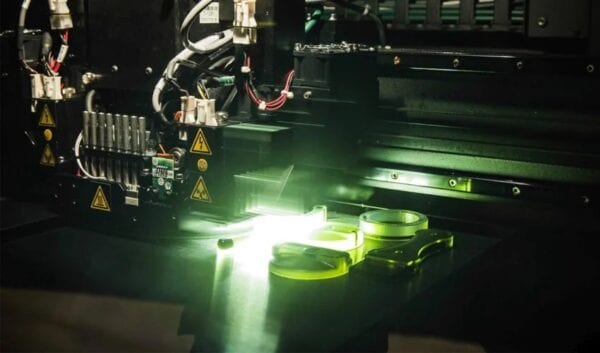
PolyJet is one of the fastest additive processes we run. It lays down fine droplets of photopolymer and cures them with UV light, so detailed parts come off the tray in hours.

PolyJet jets fine droplets of photopolymer and cures them with UV light, building smooth, highly detailed parts in hours. It prints multiple materials and full color in a single build, which makes it our go-to process for realistic prototypes and assembly models.
PolyJet combines photopolymer droplets with UV light to produce detailed components quickly. Its speed and its ability to print several materials in one job make it a strong fit when you need a prototype that looks and feels close to the final part.
We use it for realistic concept models, accurate assembly checks, and patterns for silicone molds, often turning a file into a finished part the same day.
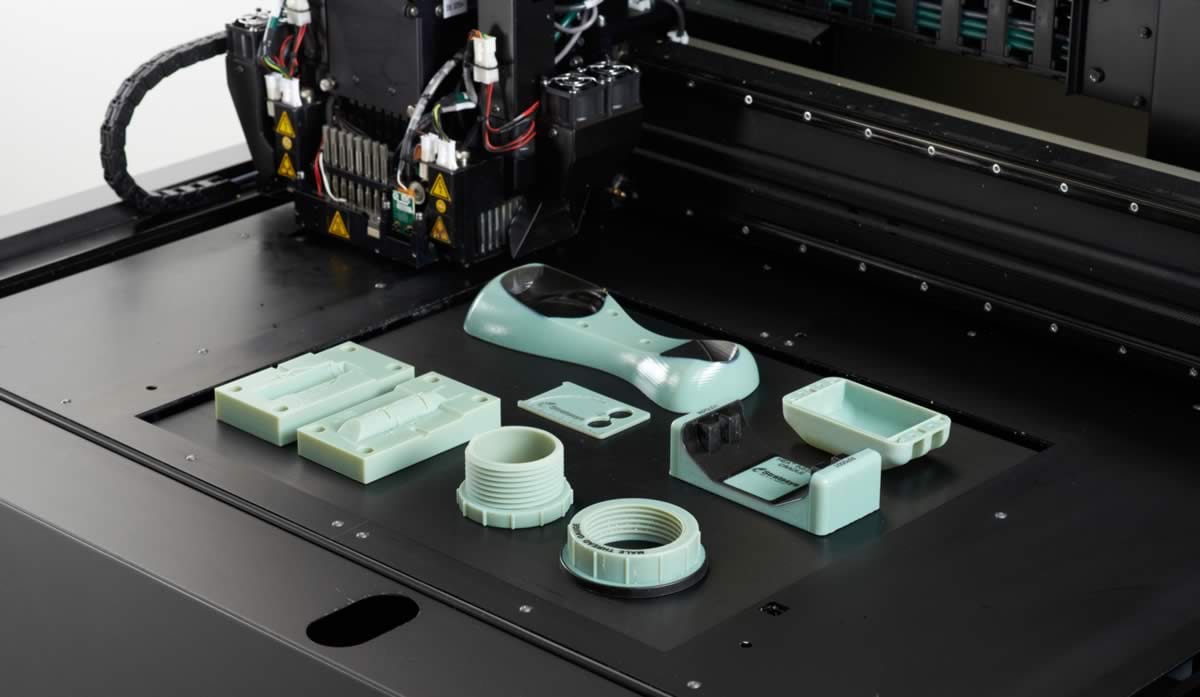
PolyJet fits businesses of all sizes because it is fast, detailed, and flexible about materials. Three traits make it stand out.
PolyJet is one of the fastest additive processes we run. It lays down fine droplets of photopolymer and cures them with UV light, so detailed parts come off the tray in hours.
A single print can combine rigid and rubber-like materials, clear and opaque sections, and full color. That makes realistic assembly models and overmolded parts possible in one build.
Fine layers and a smooth surface finish capture small features and crisp text, which suits complex geometry and presentation-ready prototypes.
PolyJet is versatile, from full-color concept models to accurate assembly checks and molds for infusion parts. Here is where it earns its place most often.
Full-color, smooth-finish models that look close to the finished product for design review and stakeholder sign-off.
Accurate multi-part models that fit together as intended, useful for checking clearances and tolerances before tooling.
Master patterns and molds for gaskets and other infusion parts, where fine detail and a clean surface matter.
Rigid and flexible materials combined in one print to mimic overmolded grips, seals, and soft-touch surfaces.
Functional and visual prototypes with complex geometry, captured at high resolution straight off the printer.
PolyJet prints in very fine layers, so it captures intricate detail and complex geometry in a fraction of the time of traditional methods. Parts come off the tray with a smooth surface that needs little finishing.
We have built a deep bench in PolyJet prototyping, and we use it across medical, consumer goods, and automotive projects where a realistic model moves a design forward.
When a part needs more than one process, PolyJet pairs well with the rest of our manufacturing capabilities, so we can take a project from concept model to functional prototype to production.
Send us your design and one of our estimators will review it for PolyJet. We will confirm the materials, color, and timeline, then get you a quote.