









Ultra-High Strength After Aging
After solution anneal and age hardening, MS1 reaches roughly 2,000 MPa yield and around 2,100 MPa tensile strength. That is why it is a common pick for loaded tool inserts and structural hardware.

Maraging Steel MS1 is the tool steel we print when a part needs very high strength after heat treatment. We build it near net shape, machine critical features while it is still workable, then age harden for final performance above 50 HRC.
Want these specifications on hand? Download the full Maraging Steel datasheet as a PDF to share with your team or attach to a drawing package.
Download Datasheet (PDF)MS1 is a low-carbon maraging steel powder designed for laser powder bed fusion. In practical terms, it gives us high strength after aging without the cracking behavior that many high-hardness steels show during printing.
The EOS chemistry corresponds to 18% Ni Maraging 300, AMS 6514, European 1.2709, and German X3NiCoMoTi 18-9-5. If your drawings already point to those families, MS1 fits naturally.
We run this alloy on our direct metal laser sintering systems for tooling and high-load parts that need steel-level strength and hardness. For corrosion-first jobs, we may steer you to stainless instead.
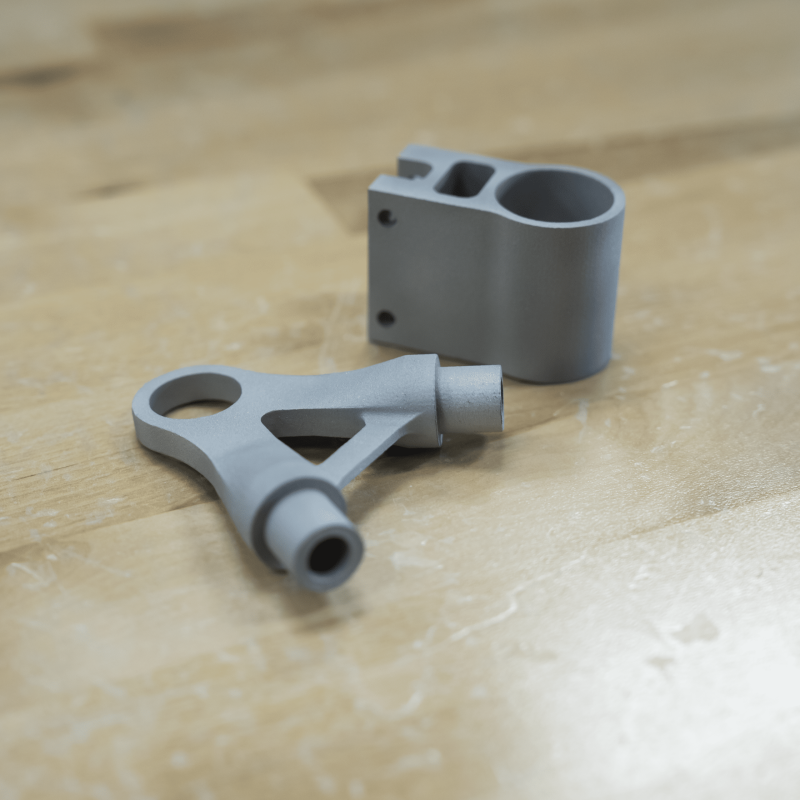
We use MS1 when a design needs additive geometry but still has to behave like hardened tool steel in service.
After solution anneal and age hardening, MS1 reaches roughly 2,000 MPa yield and around 2,100 MPa tensile strength. That is why it is a common pick for loaded tool inserts and structural hardware.
As-built material machines cleanly, so we can finish critical faces and bores before final age hardening. Then we raise hardness into the 50 to 57 HRC range for service.
MS1 suits injection mold tooling with conformal cooling channels that are hard or impossible to machine conventionally. It brings tool-steel strength to geometry that casting or milling cannot reach.
The composition maps to 18% Ni Maraging 300, AMS 6514, and 1.2709 (X3NiCoMoTi 18-9-5). For teams already specifying these grades, the material family is straightforward.
We print MS1 for production tooling and high-strength hardware in automotive, aviation, and space programs.
Core and cavity inserts with conformal cooling where cycle-time and thermal control matter more than simple geometry.
Precision steel components that need high strength and dimensional stability after heat treatment.
Compact parts under high static or cyclic loads where aluminum would not hold margin.
Tooling details and production aids that benefit from hardened surfaces after aging.
If your part needs conformal cooling, high post-heat-treatment strength, or wear-focused service life, MS1 is usually the first steel we evaluate.
These values come from the EOS MS1 material data sheet. Mechanical values listed here are for heat-treated material per ISO 6892-1, because that is the condition most end-use MS1 parts run in.
| Element | Min. | Max. |
|---|---|---|
| Fe | Balance | Balance |
| Ni | 17.0 | 19.0 |
| Co | 8.5 | 9.5 |
| Mo | 4.5 | 5.2 |
| Ti | 0.6 | 0.8 |
| Al | 0.05 | 0.15 |
| Cr | — | 0.5 |
| Cu | — | 0.5 |
| C | — | 0.03 |
| Mn | — | 0.1 |
| Si | — | 0.1 |
| P | — | 0.01 |
| S | — | 0.01 |
| System | Layer thickness | Build rate | Min. wall thickness | Inert gas | Hardness after HT |
|---|---|---|---|---|---|
| EOS M 290 | 40 µm | 4.2 mm³/s | 0.3–0.4 mm | Nitrogen | Peak ~54 HRC |
| EOS M 290 | 50 µm | Published by EOS | 0.3–0.4 mm | Nitrogen | 50–57 HRC typical |
EOS publishes both 40 µm and 50 µm M 290 parameter sets for MS1. The 40 µm set includes a reported build rate of 4.2 mm³/s and an average defect level of 0.04%.
| Process | Orientation | Yield strength Rp0.2 [MPa] | Tensile strength Rm [MPa] | Elongation at break A [%] | Young's modulus E [GPa] |
|---|---|---|---|---|---|
| EOS M 290, 40 µm | Vertical | 2010 | 2100 | 4.0 | 190 |
| EOS M 290, 40 µm | Horizontal | 2020 | 2085 | 4.5 | 190 |
| EOS M 290, 50 µm | Vertical | 2000 | 2100 | 2.0 | — |
| EOS M 290, 50 µm | Horizontal | 2030 | 2100 | 3.0 | — |
Values are averages from OEM testing and can shift with geometry, orientation, support strategy, and thermal history during the build.
| Property | Typical value | Method / condition |
|---|---|---|
| Hardness after heat treatment | 50–57 HRC | Solution anneal + age-hardened material |
| Peak hardness condition | ~54 HRC | Age at 490 °C for 6 h, then air cool |
| Fatigue strength (heat treated) | ~650 MPa | Representative OEM value for MS1 condition |
| Average defects (M 290, 40 µm) | 0.04% | Reported by EOS for published 40 µm process |
| Temperature | CTE |
|---|---|
| 25–100 °C | 10.6×10⁻⁶/K |
| 25–200 °C | 10.9×10⁻⁶/K |
| 25–300 °C | 11.2×10⁻⁶/K |
| 25–400 °C | 11.5×10⁻⁶/K |
Need these values in a handoff package? Download the MS1 datasheet PDF to share with design, tooling, and quality teams.
Download Datasheet (PDF)We typically run MS1 through a two-step cycle so the part leaves the shop in its hardened service condition.
This can be done in vacuum or inert gas. We often machine parts in the as-built state first because it is easier on tools, then age harden after final sizing.
If a job needs a different hardness or toughness balance, we can tune the aging step and document the target condition before production.
MS1 is a low-carbon, 18% nickel maraging steel powder used for laser powder bed fusion. The chemistry aligns with 18Ni Maraging 300, AMS 6514, and 1.2709. We print it when a part needs very high strength after aging and good dimensional stability through heat treatment.
Use MS1 when strength, hardness, and tooling life matter more than weight. Aluminum is better for lightweight and thermal conductivity. Stainless is better for corrosion-first environments. MS1 is usually our pick for tooling inserts, structural parts, and wear-focused applications that need post-age hardness above 50 HRC.
For most end-use jobs, yes. As-built parts machine easily, then we age harden them to reach the high-strength condition. The common route is solution annealing, rapid cooling, and a 490 °C aging cycle. That is where the material reaches its typical 50 to 57 HRC range and peak hardness around 54 HRC.
DMLS tolerances can be as tight as +/- 0.005 in. (0.13 mm) in some cases. Final accuracy still depends on geometry, orientation, support strategy, and whether features are finish machined after printing and heat treatment. Share the CAD and critical fits, and we will define a realistic tolerance plan for your part.
We see MS1 most in injection molding tools and inserts with conformal cooling, along with high-strength mechanical hardware and wear-resistant tooling components. It is a good fit where geometry is complex, lead time is tight, and conventional tool steel manufacturing would add long machining or EDM queues.
Send us your model and we will review it for DMLS in Maraging Steel (MS1), including heat-treatment condition, machining plan, tolerances, and timing.