






Static Dissipative by Design
Carbon is blended into the ABS so charge bleeds off instead of building up. Surface and volume resistance land in the ESD-safe 10⁴ to 10⁹ ohm range, so parts will not discharge into sensitive electronics.

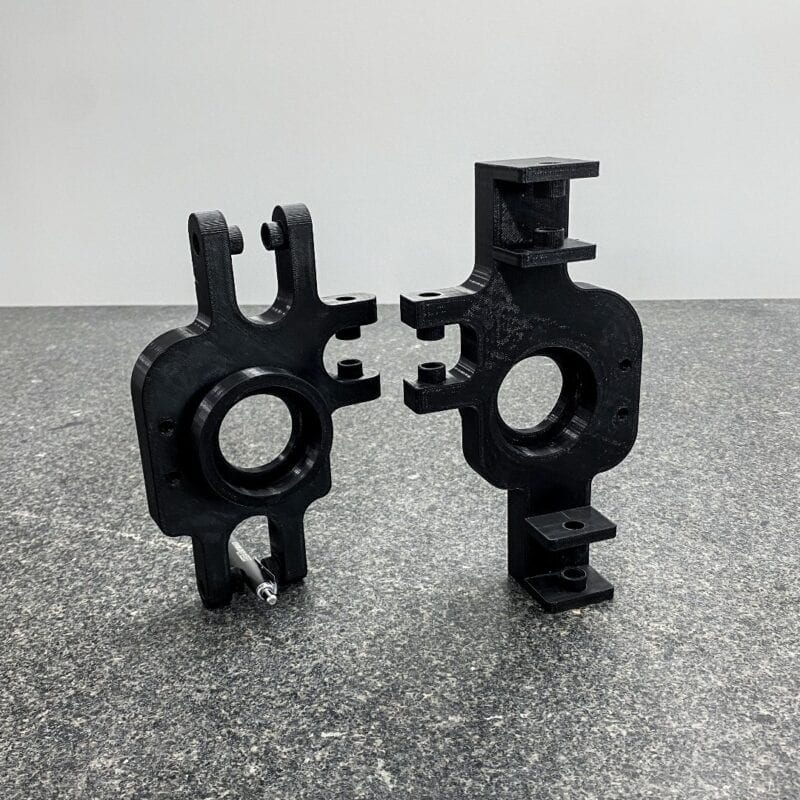
ABS-ESD7 is ABS with carbon blended in so it dissipates static instead of holding it. That makes it the grade we print for electronics fixtures, conveyor parts, and packaging, anywhere a static discharge could damage a component or attract dust.
Want these specifications on hand? Download the full ABS-ESD7 datasheet as a PDF to share with your team or attach to a drawing package.
Download Datasheet (PDF)ABS-ESD7 is an ABS thermoplastic made electrostatic dissipative (that is what the ESD stands for). Carbon is blended into the plastic so an electrical charge bleeds away across the surface rather than building up and letting go all at once. A sudden discharge can ruin a circuit board, so parts that touch electronics are often required to be ESD-safe.
Because it does not hold a charge, it also does not attract fine particles. That keeps dust, powder, and debris off the part and off whatever it handles. Underneath the ESD behavior it is still ABS, so it keeps the toughness and heat stability you would expect, with heat deflection near 101 °C.
We print it on our fused deposition modeling systems. The carbon makes ABS-ESD7 black only, so where a part needs static protection and a specific color, we would talk through the trade-offs with you.
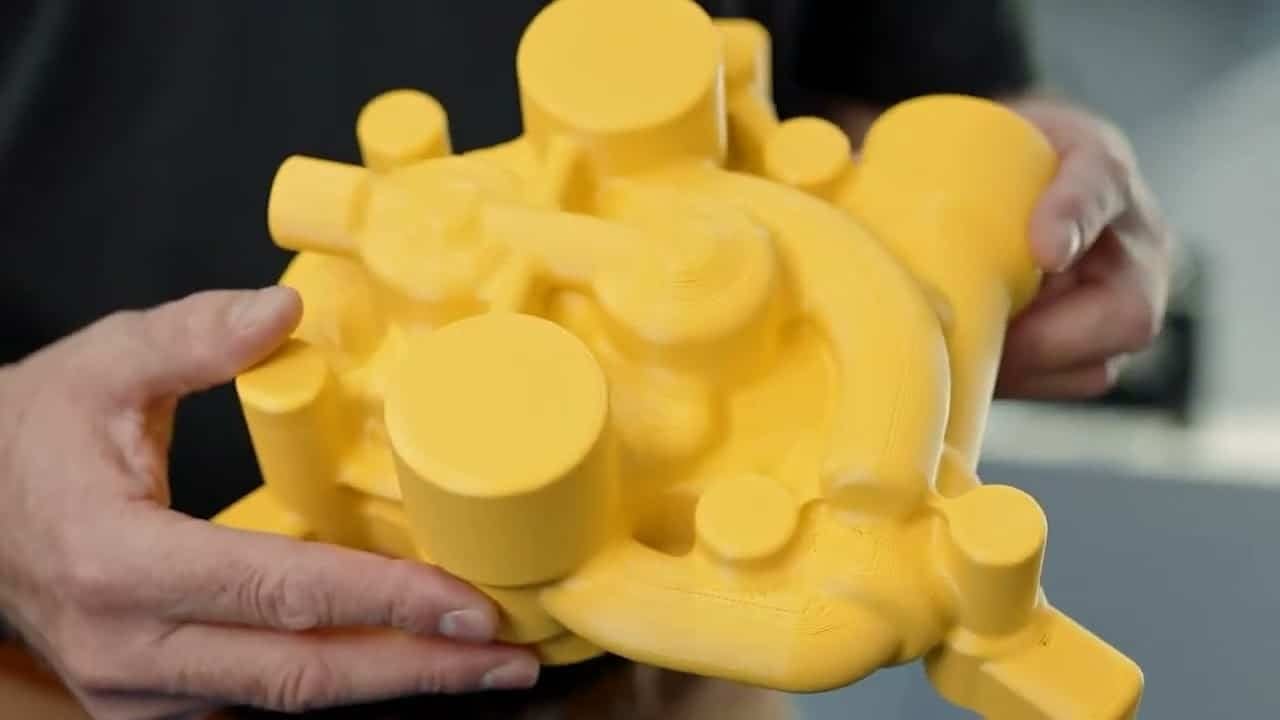
ABS-ESD7 earns its place in one clear situation: when a part cannot be allowed to build up or release a static charge.
Carbon is blended into the ABS so charge bleeds off instead of building up. Surface and volume resistance land in the ESD-safe 10⁴ to 10⁹ ohm range, so parts will not discharge into sensitive electronics.
Because it does not hold a static charge, ABS-ESD7 does not attract fine particles, powders, or dust. That matters for cleanliness around electronics assembly and powder handling.
It keeps the toughness and dimensional stability of ABS, with heat deflection near 101 °C at 264 psi. You get static protection without giving up the properties that make ABS a workhorse.
The material was made for jigs, fixtures, and tooling used to build and move electronic components, plus enclosures and packaging for static-sensitive parts.
We print ABS-ESD7 for static-sensitive work, most of it in electronics and aviation production environments.
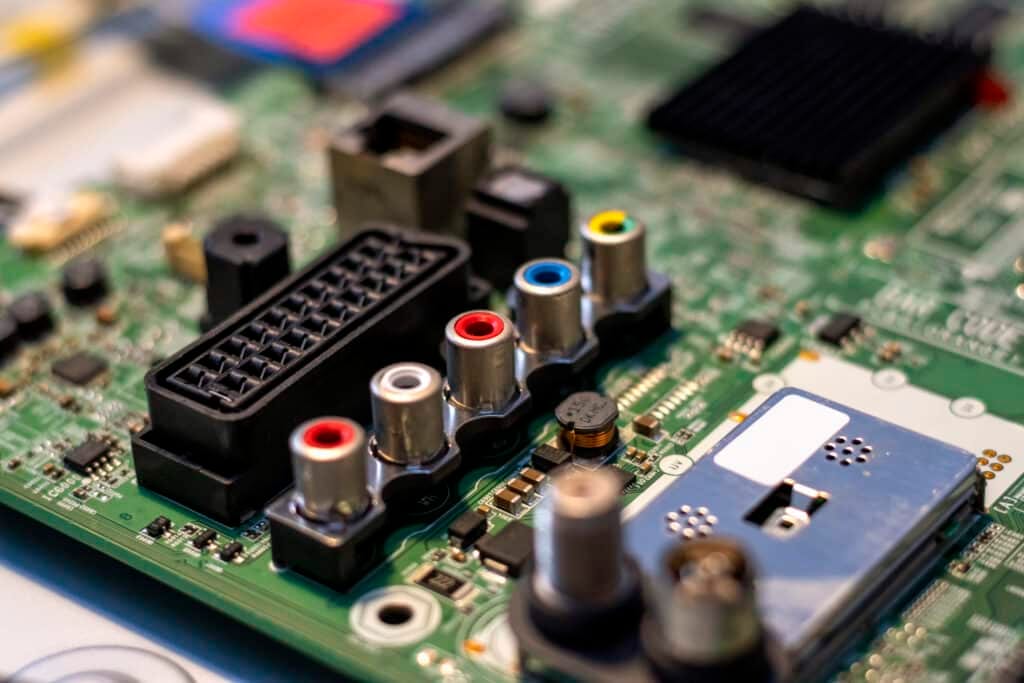
Jigs and fixtures that hold circuit boards and components during assembly without risking a static discharge.
Guides, chutes, and handling parts along a production line where charge buildup would attract dust or damage electronics.
Cases for electronic devices and instruments that need to keep static away from the boards inside.
Trays, inserts, and packaging that protect static-sensitive parts in transit and storage.
The numbers below come from the Stratasys ABS-ESD7 material data sheet. FDM parts are anisotropic, so strength depends on orientation, and Stratasys tests more than one. We list them separately rather than quoting a single figure.
Stratasys tested ABS-ESD7 per ANSI/ESD S20.20, S11.11, and STM11.12. Across geometries and build orientations, parts fall in the static-dissipative range of 10⁴ to 10⁹ ohms, with some variability in thin-walled cylinders. If your part carries a formal ESD requirement, tell us and we will plan orientation and wall thickness around it.
XZ (on-edge) runs the layers along the load and prints stronger and more ductile. ZX (upright) stacks the layers across the load, so it is weaker and often shows no distinct yield point. We orient your part to put its strength where the load is. Values are typical, printed at a 0.25 mm (0.010 in.) layer height.
| Property | Typical value | Test method |
|---|---|---|
| Specific gravity | 1.07 (at 23 °C) | ASTM D792 |
| Volume resistance | 10⁴ – 10⁹ Ω·cm (ESD-safe range) | ASTM D257 |
| Heat deflection (HDT) at 66 psi | 104.6 °C (220.2 °F) | ASTM D648, Method B |
| Heat deflection (HDT) at 264 psi | 101.4 °C (214.6 °F) | ASTM D648, Method B |
| Glass transition (Tg) | 105.5 °C (221.8 °F) | ASTM D7426 |
| Mean CTE (−50–100 °C) | 63.26 µm/m·°C (XY) / 56.15 (XZ/ZX) | ASTM E831 |
| Thermal conductivity (at 30 °C) | 0.314 W/m·K | ASTM E1952 |
| Property | F900 XZ | F900 ZX | F370 XZ | F370 ZX |
|---|---|---|---|---|
| Yield strength [MPa] | 35.4 | No yield | 33.3 | No yield |
| Elongation at yield [%] | 2.1 | — | 2.1 | — |
| Strength at break [MPa] | 33.9 | 27.0 | 31.8 | 23.2 |
| Elongation at break [%] | 3.4 | 1.59 | 2.4 | 1.8 |
| Tensile modulus [GPa] | 2.69 | 2.28 | 2.12 | 1.73 |
"No yield" means the upright (ZX) bars broke before reaching a yield point, which is typical for FDM parts loaded across the layers.
| Property | XZ orientation | ZX orientation |
|---|---|---|
| Strength at break [MPa] | No break | 44.3 |
| Strength at 5% strain [MPa] | 67.5 | — |
| Flexural modulus [GPa] | 2.41 | 2.04 |
| Property | XZ orientation | ZX orientation |
|---|---|---|
| Compressive yield strength [MPa] | 95.3 | 202 |
| Compressive modulus [GPa] | 2.39 | 2.40 |
| Izod impact, notched [J/m] | 36.2 | 20.5 |
| Izod impact, unnotched [J/m] | 198 | 85.4 |
Compression per ASTM D695, Izod impact per ASTM D256. Stratasys also publishes a full set of F370 mechanical values; the tensile figures above show how the two systems compare.
Want these specifications on hand? Download the full ABS-ESD7 datasheet as a PDF to share with your team or attach to a drawing package.
Download Datasheet (PDF)Two things drive an ABS-ESD7 part: the ESD requirement and the same orientation rules that apply to any FDM build.
ESD performance depends on geometry. Stratasys found resistance stays in the safe range across most shapes, but thin-walled cylinders can vary. If a part has to meet a specific resistance spec, we plan wall thickness and orientation to hit it, and we can print test geometry first when the requirement is tight.
Orientation drives strength. A part is strongest along its layers and weakest across them, so we point the layers to carry the load. ABS-ESD7 sands, paints, and bonds like other ABS grades, though painting can cover the conductive surface, so we confirm that any coating step is compatible with the ESD requirement.
ESD stands for electrostatic dissipative. ABS-ESD7 has carbon blended into the ABS so an electrical charge drains away gradually instead of building up and releasing all at once. A sudden static discharge can destroy a circuit board or component, so parts that touch electronics are often required to be ESD-safe.
Its surface resistance sits in the electrostatic-dissipative range of 10⁴ to 10⁹ ohms, tested per ANSI/ESD S20.20. That is the sweet spot: conductive enough to bleed off static, but not so conductive that it acts like a wire. Stratasys found the material stays in this range across most geometries, with some variability in thin-walled cylinders.
They share the same ABS base and similar heat resistance, but ABS-ESD7 adds carbon for static dissipation, which also makes it black only. ABS-M30 is the general-purpose workhorse; choose ABS-ESD7 specifically when a part needs to protect electronics from static or avoid attracting dust and powder.
It is built for electronics work: jigs and fixtures that hold circuit boards during assembly, conveyor and line-handling parts, enclosures and housings for electronic devices, and static-safe trays and packaging. Anywhere charge buildup could damage a component or pull in dust is a good fit.
It sands, paints, and bonds like other ABS grades, but painting can cover the conductive surface and change the ESD behavior. If your part has a formal ESD requirement, we confirm that any coating or finishing step is compatible before we apply it.
ABS-ESD7 comes in black only, because the carbon that gives it static dissipation also darkens the plastic. If you need a static-safe part in another color, painting is an option, but it has to be checked against the ESD requirement first.
Send us your design and one of our estimators will review it for FDM in ABS-ESD7. We will confirm the material, any ESD requirement, orientation, and timeline, then get you a quote.