






Holds Up Outdoors
ASA was made to resist UV. In Stratasys testing, parts held their strength after 1,000 hours of accelerated UV and weathering. That is the main reason to pick it over ABS for anything that lives outside.

ASA is the UV-resistant cousin of ABS. It prints with cleaner surfaces, comes in more colors than any other FDM material, and holds its strength and color outdoors, which is why we reach for it on parts that face sunlight and weather.
Want these specifications on hand? Download the full ASA datasheet as a PDF to share with your team or attach to a drawing package.
Download Datasheet (PDF)ASA (acrylonitrile styrene acrylate) is a general-purpose thermoplastic that behaves a lot like ABS but resists ultraviolet light much better. Ordinary ABS fades and gets brittle in sunlight; ASA was formulated to shrug that off, so it keeps its color and strength outdoors.
Along with the UV resistance, ASA prints with a cleaner surface and is available in more colors than any other FDM material. Mechanically it sits right alongside ABS, so you are not giving up strength or stiffness to get the weathering and cosmetic benefits.
We print ASA on our fused deposition modeling systems. When a part will see sun, rain, or just needs to look good in a specific color, it is one of our first suggestions.
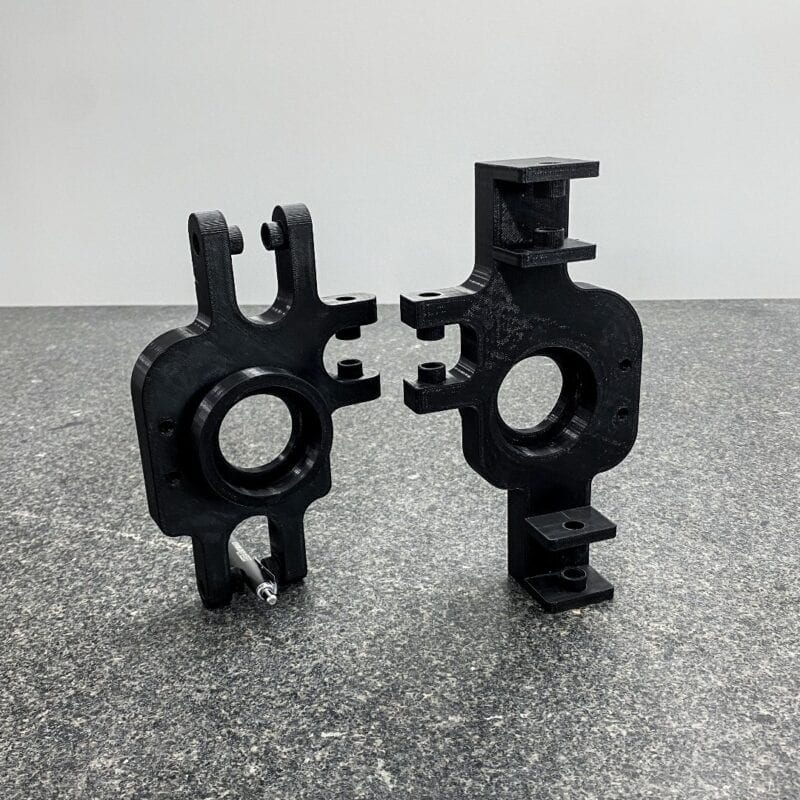
ASA is what we reach for when a part looks like an ABS job but needs to survive sunlight or look its best.
ASA was made to resist UV. In Stratasys testing, parts held their strength after 1,000 hours of accelerated UV and weathering. That is the main reason to pick it over ABS for anything that lives outside.
ASA prints with better surface aesthetics than ABS and comes in more colors than any other FDM material. When appearance matters, it is an easy choice.
Strength, stiffness, and toughness land right in ABS territory, with tensile strength near 33 MPa and heat deflection around 98 °C. You trade nothing mechanically to gain the UV and cosmetic advantages.
It is a broad-use commodity thermoplastic, at home in prototypes, jigs and fixtures, and low-volume production. If a part does not need heat, chemical, or ESD performance and might see sunlight, ASA fits.
ASA shows up across consumer goods and automotive work, wherever weather and appearance both matter.
Housings, brackets, and covers that face sunlight and weather without fading or getting brittle.
Form-and-fit and working prototypes where a clean surface and stable color help the review.
Shop-floor tooling that needs to be tough and dimensionally stable but not high-heat or ESD-safe.
End-use parts in modest quantities, especially cosmetic ones where color choice matters.
The numbers below come from the Stratasys ASA material data sheet. FDM parts are anisotropic, so strength depends on orientation, and Stratasys tests more than one. We list them separately rather than quoting a single figure.
Stratasys cycled ASA in a QUV chamber per ASTM G154 for 1,000 hours. After exposure, tensile stress at break changed only marginally (from 30.5 MPa to 29.5 MPa), confirming ASA holds up where ABS would fade and embrittle. This is the reason to choose it for outdoor parts.
XZ (on-edge) runs the layers along the load and prints stronger and more ductile. ZX (upright) stacks the layers across the load, so it is weaker and often shows no distinct yield point. We orient your part to put its strength where the load is. Values are typical, printed at a 0.25 mm (0.010 in.) layer height.
| Property | Typical value | Test method |
|---|---|---|
| Specific gravity | 1.08 (at 23 °C) | ASTM D792 |
| Heat deflection (HDT) at 66 psi | 103 °C (217 °F) XY / 102 °C ZX | ASTM D648, Method B |
| Heat deflection (HDT) at 264 psi | 98.2 °C (209 °F) XY / 97.6 °C ZX | ASTM D648, Method B |
| Glass transition (Tg) | 104 °C (219 °F) | ASTM D7426 |
| Mean CTE (−50–90 °C) | 69.38 µm/m·°C (XY) / 63.55 (ZX) | ASTM E831 |
| Volume resistivity | > 6.89 × 10¹⁴ Ω·cm | ASTM D257 |
| Thermal conductivity (at 30 °C) | 0.164 W/m·K | ASTM E1952 |
| Property | F900 XZ | F900 ZX | F770 XZ | F770 ZX |
|---|---|---|---|---|
| Yield strength [MPa] | 32.8 | No yield | 35.2 | 26.9 |
| Elongation at yield [%] | 2.5 | — | 3.0 | 2.3 |
| Strength at break [MPa] | 31.9 | 28.3 | 33.7 | 27.0 |
| Elongation at break [%] | 5.9 | 1.8 | 8.4 | 2.3 |
| Tensile modulus [GPa] | 2.14 | 2.05 | 1.85 | 1.62 |
F900 values are for ASA black; F770 values are for ASA ivory. "No yield" means the upright (ZX) bars broke before reaching a yield point, which is typical for FDM parts loaded across the layers.
| Property | XZ orientation | ZX orientation |
|---|---|---|
| Strength at break [MPa] | No break | 51.0 |
| Strength at 5% strain [MPa] | 61.5 | — |
| Flexural modulus [GPa] | 1.98 | 1.76 |
| Property | XZ orientation | ZX orientation |
|---|---|---|
| Compressive yield strength [MPa] | 75.4 | 188 |
| Compressive modulus [GPa] | 2.05 | 2.42 |
| Izod impact, notched [J/m] | 43.1 | 23.8 |
| Izod impact, unnotched [J/m] | 285 | 91.1 |
Compression per ASTM D695, Izod impact per ASTM D256. Stratasys also publishes mechanical data for the F3300 and additional layer heights.
Want these specifications on hand? Download the full ASA datasheet as a PDF to share with your team or attach to a drawing package.
Download Datasheet (PDF)A few things worth knowing before you send an ASA part. Most of them come down to orientation and finishing.
Orientation drives strength. A part is strongest along its layers and weakest across them, so we point the layers to carry the load and keep them out of any bending plane that matters. If a feature has to be strong in every direction, tell us and we will plan for it.
Color is a real advantage here. ASA comes in the widest range of any FDM material, so for cosmetic parts we can often print the finished color rather than paint it. It also sands, primes, paints, and bonds well when you do want a specific finish.
For outdoor parts, the UV resistance is built in, but soluble support still washes out of internal channels and pockets, so enclosed features are on the table.
They are close relatives with similar strength and stiffness, but ASA resists ultraviolet light far better. ABS fades and gets brittle in sunlight, while ASA holds its color and properties outdoors. ASA also prints with a cleaner surface and comes in more colors. If a part will see sun or needs to look good, ASA is usually the better pick.
Yes, that is its strong suit. In Stratasys testing, ASA held its strength after 1,000 hours of accelerated UV and weathering per ASTM G154. It is a good choice for housings, brackets, and covers that face sun and rain.
ASA is available in more colors than any other FDM material, including black, white, grays, red, blue, green, yellow, orange, and ivory. For cosmetic parts we can often print the finished color instead of painting it. Tell us the color you need and we will confirm availability.
Its mechanical properties sit right alongside ABS-M30: tensile strength around 33 MPa and heat deflection near 98 °C. It is a solid general-purpose material. For higher heat or chemical resistance you would move up to polycarbonate or a nylon, but for most prototyping and low-volume production ASA is plenty.
Choose ASA when the part will see sunlight, needs to resist weathering, or has to look its best in a specific color. If none of that applies and you just need a tough, low-cost workhorse, ABS-M30 is usually the more economical choice.
Yes. ASA sands, primes, paints, and bonds well, and soluble support washes out of internal channels so enclosed features are possible. That said, its wide color range often means you can skip painting for cosmetic parts.
Send us your design and one of our estimators will review it for FDM in ASA. We will confirm the material, color, orientation, and timeline, then get you a quote.