




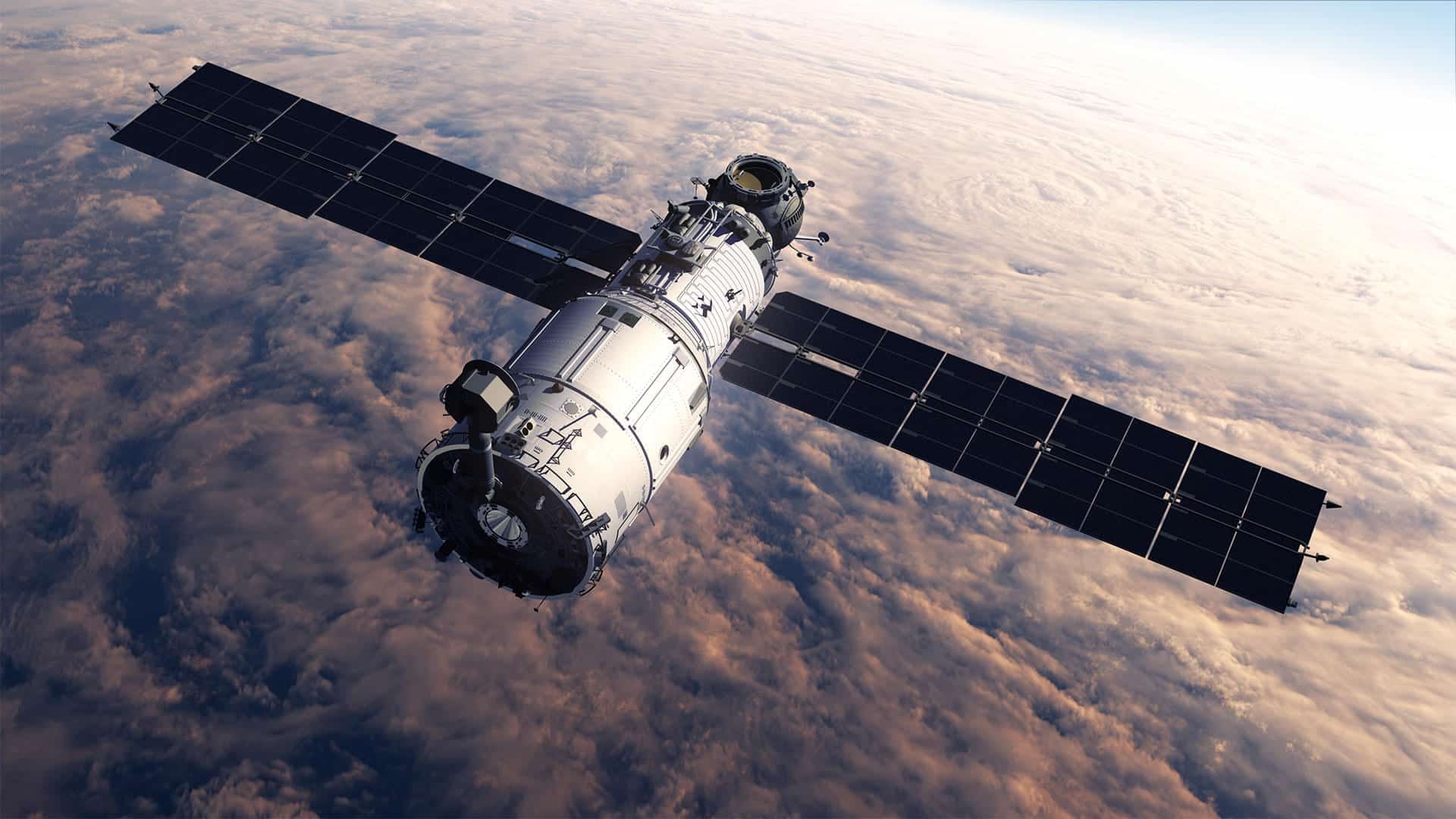




Highest Stiffness-to-Weight
Chopped carbon fiber, 35% by weight, gives Nylon 12CF the highest flexural strength of any FDM thermoplastic and a tensile modulus near 9.5 GPa. Pound for pound, nothing in our standard FDM lineup is stiffer.

Nylon 12CF is PA12 reinforced with 35% chopped carbon fiber. It has the highest flexural strength and stiffness-to-weight of any FDM thermoplastic, which makes it our metal-replacement material for strong, lightweight tooling and load-bearing parts.
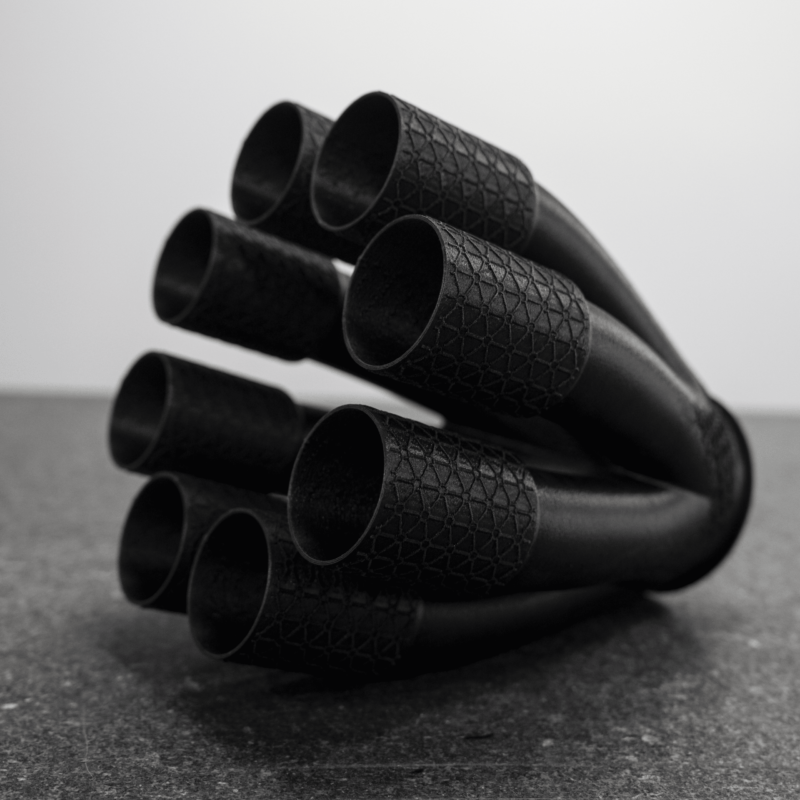
Want these specifications on hand? Download the full Nylon 12CF datasheet as a PDF to share with your team or attach to a drawing package.
Download Datasheet (PDF)Nylon 12CF is a PA12 (polyamide 12) filament reinforced with chopped carbon fiber, 35% by weight. The fiber transforms the material: it has the highest flexural strength of any FDM thermoplastic and, as a result, the highest stiffness-to-weight ratio in the lineup.
That combination of high strength, high stiffness, and light weight is what makes it a genuine replacement for heavier metal components in the right applications. Tensile modulus reaches 9.46 GPa and flexural strength 153 MPa in the strong orientation, with heat deflection between 130 and 168 °C.
We print Nylon 12CF on our fused deposition modeling systems. The carbon fiber makes it highly directional, so it is strongest along the layers; we plan the build to align that strength with your load path.
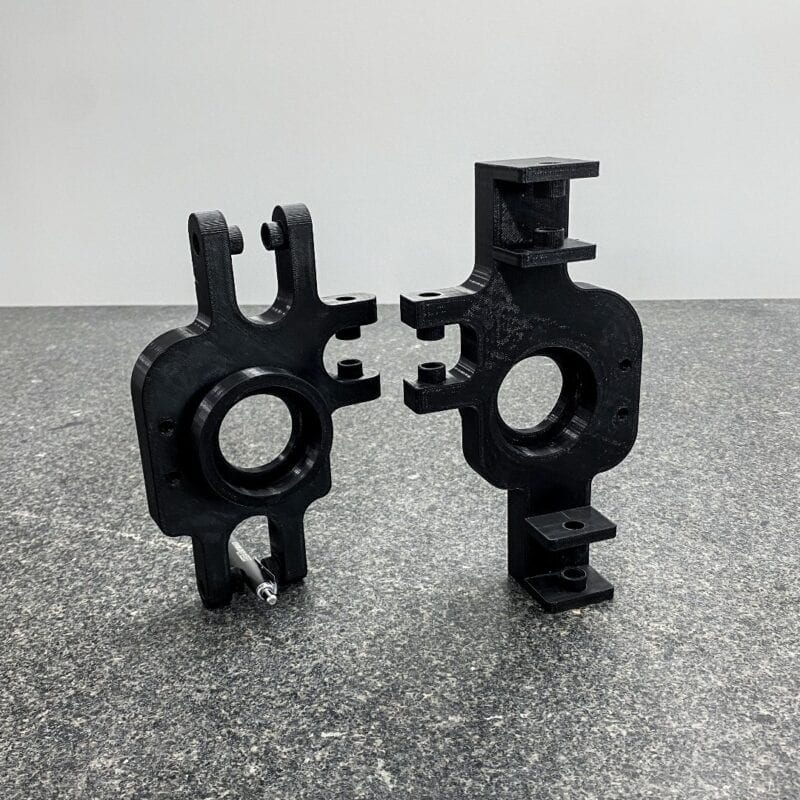
Nylon 12CF is the material we reach for when a part needs metal-like stiffness at a fraction of the weight.
Chopped carbon fiber, 35% by weight, gives Nylon 12CF the highest flexural strength of any FDM thermoplastic and a tensile modulus near 9.5 GPa. Pound for pound, nothing in our standard FDM lineup is stiffer.
The blend of high strength, high stiffness, and light weight makes it a real option to replace heavier aluminum or steel in the right parts, especially tooling and brackets.
Heat deflection reaches 130 to 168 °C depending on orientation, so it holds up in warm environments as well as heavy loads.
It carries load like a structural material while staying easy to handle, which is exactly what you want in strong, lightweight fixtures and functional prototypes.
Nylon 12CF shows up across aviation, automotive, and space work, wherever weight savings and stiffness both count.
Jigs, fixtures, and tooling that need metal-like stiffness without metal-like weight.
Brackets and mounts where carbon-fiber nylon can stand in for machined aluminum in the right use case.
Structural prototypes that must carry real load and validate stiffness before production.
Load-bearing components where high stiffness-to-weight is the deciding factor.
The numbers below come from the Stratasys FDM Nylon 12CF material data sheet. Fiber-reinforced FDM parts are strongly anisotropic, so orientation matters even more than usual. We list the orientations separately rather than quoting a single figure.
The gap between orientations is dramatic here. XZ (on-edge) runs the layers and the fiber along the load and is enormously stronger and stiffer; ZX (upright) stacks the layers across the load and relies on the nylon matrix between them. Aligning the part with its load path is essential. Values are typical at a 0.25 mm (0.010 in.) layer height on the F900 (T20C tip) and the Fortus 450mc (T20C tip).
| Property | Typical value | Test method |
|---|---|---|
| Reinforcement | 35% chopped carbon fiber by weight | — |
| Specific gravity | 1.19 (at 23 °C) | ASTM D257 |
| Heat deflection (HDT) at 66 psi | 160 °C (320 °F) XY / 168 °C ZX | ASTM D648, Method B |
| Heat deflection (HDT) at 264 psi | 130 °C (266 °F) XY / 154 °C ZX | ASTM D648, Method B |
| Glass transition (Tg) | 37.5 °C (99.5 °F) | ASTM D7426 |
| Volume resistivity | 2.84 × 10⁷ Ω·cm | ASTM D257 |
| Thermal conductivity (at 30 °C) | 0.599 W/m·K | ASTM E1952 |
| Property | F900 XZ | F900 ZX | 450mc XZ | 450mc ZX |
|---|---|---|---|---|
| Yield strength [MPa] | No yield | No yield | 77.5 | 38.3 |
| Strength at break [MPa] | 83.5 | 32.7 | 76.5 | 38.4 |
| Elongation at break [%] | 2.4 | 1.2 | 3.2 | 2.2 |
| Tensile modulus [GPa] | 9.46 | 3.00 | 7.91 | 2.64 |
"No yield" means the fiber-reinforced bars broke without a distinct yield point, which is typical for filled materials. On the F900 the material tests stiffer; the Fortus 450mc reports a measurable yield.
| Property | F900 XZ | F900 ZX | 450mc XZ | 450mc ZX |
|---|---|---|---|---|
| Strength at break [MPa] | 153 | 62.4 | 152 | 67.4 |
| Strain at break [%] | 2.65 | 3.10 | 2.7 | 3.6 |
| Flexural modulus [GPa] | 11.1 | 2.34 | 11.0 | 2.18 |
| Property | XZ orientation | ZX orientation |
|---|---|---|
| Compressive yield strength [MPa] | 110 | 141 |
| Compressive modulus [GPa] | 6.78 | 3.67 |
| Izod impact, notched [J/m] | 106 | 24 |
| Izod impact, unnotched [J/m] | 346 | 121 |
Compression per ASTM D695, Izod impact per ASTM D256. A thicker 0.020 in. (0.508 mm) layer with the T40C tip pushes XZ tensile strength and modulus higher still (up to ~124 MPa and 15.4 GPa); ask us if maximum stiffness is the goal.
Want these specifications on hand? Download the full Nylon 12CF datasheet as a PDF to share with your team or attach to a drawing package.
Download Datasheet (PDF)A few things worth knowing before you send a Nylon 12CF part. Orientation matters more here than with any other standard FDM material.
Orientation is everything. Because the carbon fiber aligns with the print path, the part can be several times stiffer and stronger along the layers than across them. We design the build around your load path, and if a feature must be strong in more than one direction we plan for it up front rather than after the fact.
Think of it as directional, like a composite. It is a metal-replacement material for the right parts, but it is not isotropic like machined aluminum, so a part that sees load from every direction needs a conversation about geometry and orientation. Layer height also trades finish and speed for stiffness; a thicker fiber-aligned layer maximizes strength.
Like all nylons, it absorbs moisture, so we store and handle the filament dry and account for it on tight-tolerance parts. Soluble support washes out of internal channels and pockets, so enclosed features are on the table.
It is FDM Nylon 12 (PA12) reinforced with chopped carbon fiber, 35% by weight. The fiber gives it the highest flexural strength and stiffness-to-weight ratio of any FDM thermoplastic, which is why it is used as a lightweight metal replacement for the right parts.
In the right applications, yes. Its combination of high strength, high stiffness, and low weight lets it stand in for heavier aluminum or steel in parts like tooling and brackets. The key caveat is that it is directional, not isotropic like machined metal, so we design the part and its orientation around the load path.
The carbon fiber aligns with the print path, so the part can be several times stiffer and stronger along the layers than across them. Tensile modulus is about 9.46 GPa along the layers versus 3.0 GPa across them. We plan the build to point that strength along your load path, and we flag any part that must carry load from multiple directions.
Much stiffer. Tensile modulus jumps from around 1.5 GPa for unfilled Nylon 12 to 9.46 GPa for Nylon 12CF, and flexural strength reaches 153 MPa. The trade-off is ductility: the fiber-reinforced grade elongates only a few percent before breaking, so it is chosen for rigidity rather than flex.
Quite. Heat deflection ranges from about 130 °C to 168 °C depending on orientation, higher than unfilled Nylon 12 and comparable to polycarbonate. That lets it handle warm environments as well as heavy loads.
Like all nylons it absorbs moisture, so we store and handle the filament dry and account for it on tight-tolerance parts. It also requires hardened machine hardware because the carbon fiber is abrasive, which our systems are equipped for. Soluble support washes out of internal channels, so enclosed features are possible.
Send us your design and one of our estimators will review it for FDM in Nylon 12CF. We will confirm the material, orientation, and timeline, then get you a quote.