



Best of Both Plastics
PC-ABS blends polycarbonate and ABS, so you get much of the strength and heat resistance of PC with the toughness and printability of ABS. It sits above plain ABS without jumping to the cost of full polycarbonate.

PC-ABS blends polycarbonate and ABS to land in a useful middle ground: much of the strength and heat resistance of PC with the toughness and printability of ABS. We reach for it when a part needs to be tougher and take more heat than ABS, without the cost of full polycarbonate.
Want these specifications on hand? Download the full PC-ABS datasheet as a PDF to share with your team or attach to a drawing package.
Download Datasheet (PDF)PC-ABS is exactly what the name suggests: a blend of polycarbonate (PC) and acrylonitrile butadiene styrene (ABS). Blending the two captures the best of each. PC brings strength and heat resistance; ABS brings impact toughness and easy, stable printing. The result is a material that outperforms plain ABS in a couple of important ways.
The standout is impact resistance. Notched Izod reaches 241 J/m in the strong orientation, which is several times what ABS provides. Heat deflection also climbs to 125 °C at 66 psi, giving parts more room in warm environments.
We print PC-ABS on our fused deposition modeling systems in black and white. Choose it when you need the strength of PC but the impact resistance of ABS.
PC-ABS is the step up from ABS when a part needs more toughness and heat resistance but does not justify full polycarbonate.
PC-ABS blends polycarbonate and ABS, so you get much of the strength and heat resistance of PC with the toughness and printability of ABS. It sits above plain ABS without jumping to the cost of full polycarbonate.
Notched Izod impact reaches 241 J/m in the strong orientation, several times what ABS delivers. When a part takes knocks, drops, or snap-loads, PC-ABS holds together.
Heat deflection climbs to 125 °C at 66 psi, noticeably higher than ABS or ASA. Parts that see warm environments or under-hood heat get more margin here.
It prints with good dimensional stability and finishes cleanly, which makes it a dependable choice for tooling and functional prototypes that need to look and fit right.
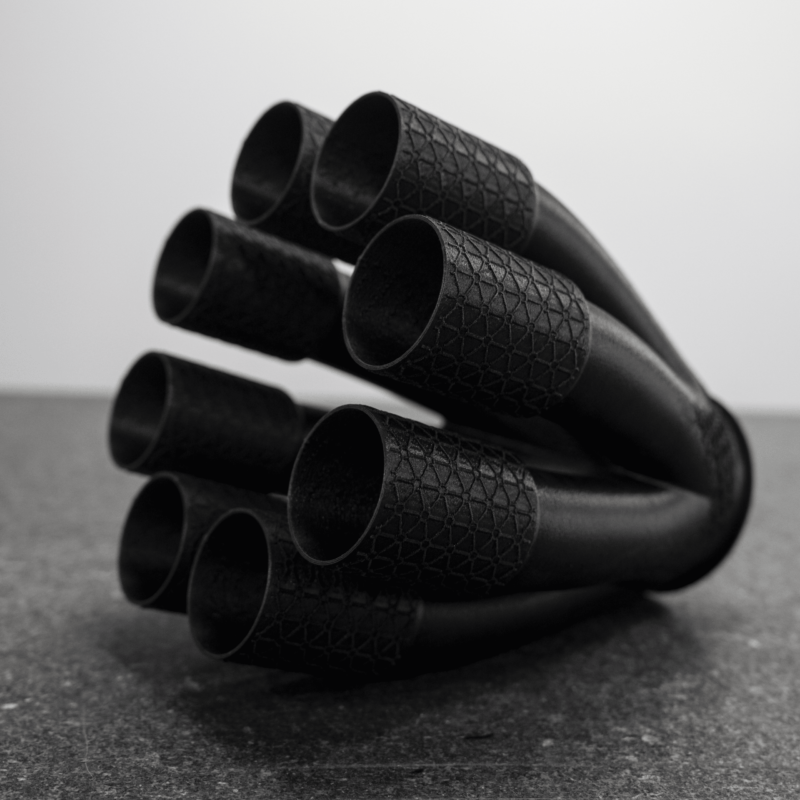
PC-ABS shows up across automotive and aviation work, wherever toughness and a bit of heat resistance both matter.
Working prototypes that need real strength and impact resistance before committing to production tooling.
Jigs, fixtures, and tools that take repeated handling and the occasional impact on the shop floor.
Cases and covers that need to survive drops and warm environments better than ABS can.
End-use parts in modest quantities where toughness and a bit of heat resistance both matter.
The numbers below come from the Stratasys PC-ABS material data sheet. FDM parts are anisotropic, so strength depends on orientation, and Stratasys tests more than one. We list them separately rather than quoting a single figure.
XZ (on-edge) runs the layers along the load and prints stronger and far tougher. ZX (upright) stacks the layers across the load, so it is weaker and often shows no distinct yield point. We orient your part to put its strength where the load is. Values are typical, printed on the F900 at a 0.25 mm (0.010 in.) layer height.
| Property | Typical value | Test method |
|---|---|---|
| Specific gravity | 1.10 (at 23 °C) | ASTM D257 |
| Heat deflection (HDT) at 66 psi | 125.0 °C (257.1 °F) | ASTM D648, Method B |
| Heat deflection (HDT) at 264 psi | 102.9 °C (217.2 °F) | ASTM D648, Method B |
| Glass transition (Tg) | 105.3 °C (221.6 °F) | ASTM D7426 |
| Mean CTE (−50–95 °C) | 72.96 µm/m·°C (XZ/ZX) | ASTM E831 |
| Volume resistivity | > 6.84 × 10¹⁴ Ω·cm | ASTM D257 |
| Property | XZ orientation | ZX orientation |
|---|---|---|
| Yield strength [MPa] | 36.5 | No yield |
| Elongation at yield [%] | 3.0 | — |
| Strength at break [MPa] | 34.7 | 25.9 |
| Elongation at break [%] | 4.7 | 1.8 |
| Tensile modulus [GPa] | 1.99 | 1.87 |
"No yield" means the upright (ZX) bars broke before reaching a yield point, which is typical for FDM parts loaded across the layers.
| Property | XZ orientation | ZX orientation |
|---|---|---|
| Strength at break [MPa] | No break | 46.2 |
| Strength at 5% strain [MPa] | 61.9 | — |
| Flexural modulus [GPa] | 1.86 | 1.68 |
| Property | XZ orientation | ZX orientation |
|---|---|---|
| Compressive yield strength [MPa] | 96.5 | 172 |
| Compressive modulus [GPa] | 2.14 | 1.85 |
| Izod impact, notched [J/m] | 241 | 34.0 |
| Izod impact, unnotched [J/m] | 655 | 101 |
Compression per ASTM D695, Izod impact per ASTM D256.
Want these specifications on hand? Download the full PC-ABS datasheet as a PDF to share with your team or attach to a drawing package.
Download Datasheet (PDF)A few things worth knowing before you send a PC-ABS part. Most of them come down to orientation and finishing.
Orientation drives strength, and it matters even more for PC-ABS because the toughness gap between orientations is large. Notched impact is roughly seven times higher along the layers than across them, so we point the layers to carry impact and load. If a feature has to be tough in every direction, tell us and we will plan for it.
Finishing is straightforward. PC-ABS sands, primes, paints, and bonds well, and soluble support washes out of internal channels and pockets, so enclosed features are on the table. It is available in black and white.
PC-ABS is a blend of polycarbonate (PC) and acrylonitrile butadiene styrene (ABS). Blending the two captures much of the strength and heat resistance of PC along with the impact toughness and easy printing of ABS. It sits above plain ABS without the cost or difficulty of full polycarbonate.
PC-ABS is tougher and takes more heat. Notched Izod impact reaches 241 J/m in the strong orientation, several times higher than ABS, and heat deflection climbs to 125 °C at 66 psi versus roughly 96 °C for ABS-M30. Choose PC-ABS when a part needs to survive impacts or warmer environments; choose ABS-M30 when cost is the priority and those demands are lower.
PC-ABS is the middle step. It gives more toughness than ABS and more heat resistance too, but full PC is stronger and handles higher temperatures (heat deflection around 140 °C). If your part needs maximum strength and heat, go to PC. If it needs a balance of toughness and heat at lower cost, PC-ABS is the sweet spot.
Very, in the right orientation. Notched Izod impact is about 241 J/m along the layers, so parts resist drops, knocks, and snap-loads well. That toughness drops when the part is loaded across the layers, which is why we orient the build to put strength where the impact will land.
PC-ABS is available in black and white. It also sands, primes, paints, and bonds well if you need a specific finish or color beyond those two.
Functional prototypes, manufacturing jigs and fixtures, enclosures and housings that must survive drops and warm environments, and low-volume production parts. It is a strong general-purpose upgrade whenever toughness and a bit of heat resistance both matter.
Send us your design and one of our estimators will review it for FDM in PC-ABS. We will confirm the material, orientation, and timeline, then get you a quote.