








DMLS Motor Cooling Sleeve: How Illini Electric Motorsports Engineered Around Thermal Runaway
How the University of Illinois Urbana-Champaign’s Illini Electric Motorsports team used Direct Metal Laser Sintering to manufacture a lightweight, indirect motor cooling sleeve with a helical internal flow path.
- Industry
- Formula SAE Electric
- Process
- DMLS Metal 3D Printing
- Material
- DMLS Aluminum
- Application
- Motor Cooling Sleeve
The Challenge: Keeping an Electric Motor Below the Derating Cliff
For an electric Formula SAE car, heat is more than an efficiency problem. It can determine how much performance is available on track.
The biggest source of that heat is not ambient temperature. It is electrical resistance inside the motor. As current moves through the copper windings, resistive losses generate heat. As those windings get hotter, their resistance increases. That creates a feedback loop: more resistance generates more heat, which increases resistance further. Eventually the motor reaches what Illini Electric Motorsports calls the derating cliff.
The team’s AMK motors include protection systems that monitor winding temperature. If temperatures climb past the safety threshold, the controller reduces available power. Torque drops, performance suffers, and in an endurance event the consequences can be significant.
The goal of the motor cooling sleeve was simple: keep the motor below that thermal threshold so the car could hold performance without forcing the system to derate.
Engineering the Cooling System Around Thermal Resistance
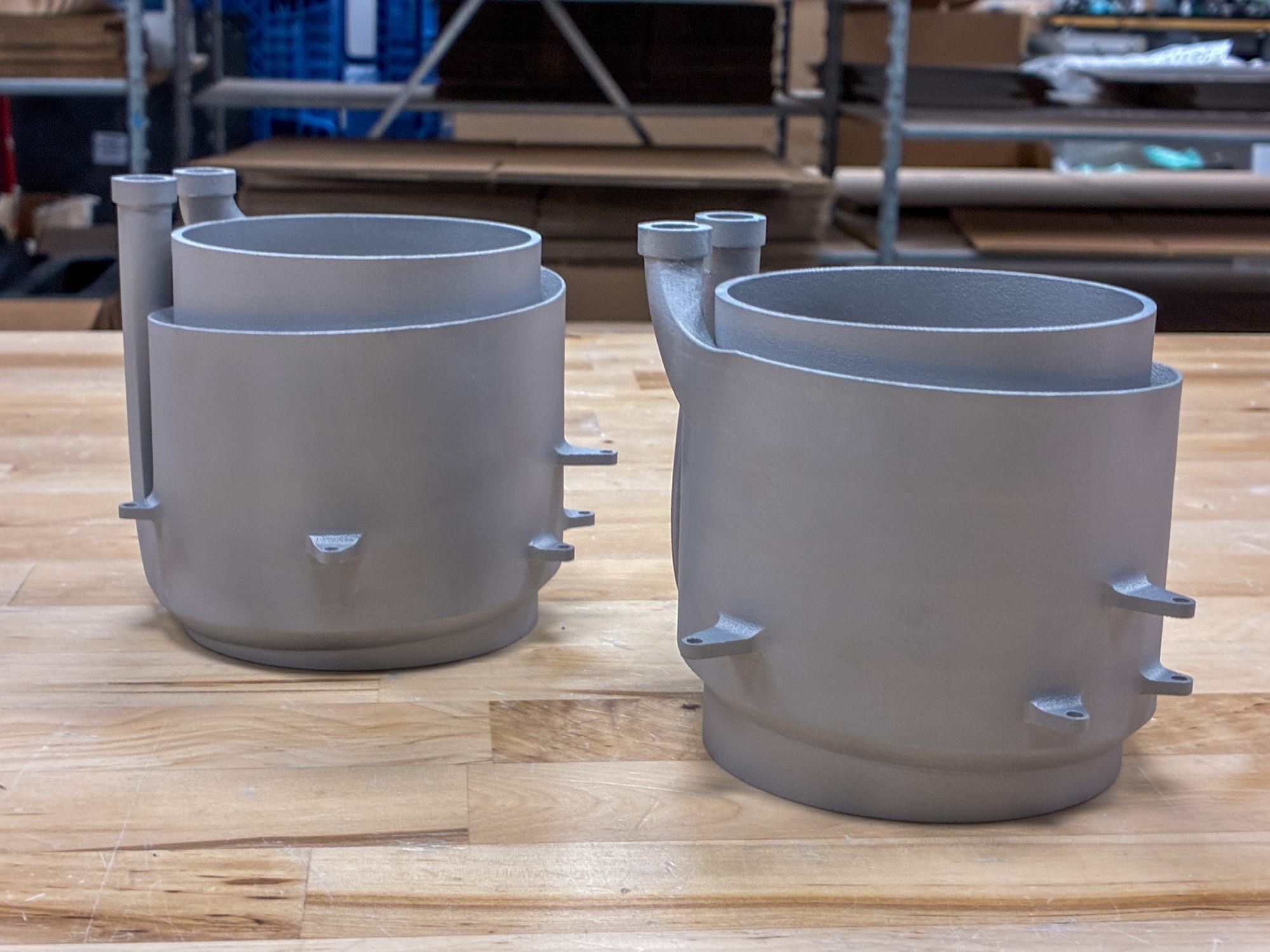
Cooling an electric motor is not as simple as circulating water around the outside of the housing the way you would on a traditional internal combustion engine. Illini Electric Motorsports treated the cooling sleeve as part of the complete thermal system, not an add-on cooler.
The team modeled heat transfer using thermal resistance:
Thermal Resistance Model
- Relationship
- ΔT = Q × Rth
- ΔT
- Temperature difference
- Q
- Heat flow
- Rth
- Thermal resistance
The concept is similar to Ohm’s Law, except it measures temperature instead of voltage. The objective of the cooling sleeve is to minimize thermal resistance between the motor and the coolant so heat can leave the motor as efficiently as possible. That made the internal fluid geometry a first-order design problem.
A simple straight or hollow water jacket would not provide the cooling the team needed to stay on track for hours. Instead, Illini designed a helical coolant path that forces fluid to spiral around the motor housing. The longer flow path increases coolant contact with the motor and promotes turbulence, which disrupts the hot boundary layer along the motor surface and improves convective heat transfer compared with a simpler laminar path.
The geometry worked thermally. It created another problem: how do you manufacture a sleeve with an internal cooling passage that follows complex curves?
Why an Indirect Cooling Sleeve?
Early in development the team made another important decision: the coolant would not flow directly against the motor housing.
Illini designed an indirect cooling sleeve, with a solid wall separating the coolant passage from the motor. It can look less effective on paper. The tradeoff was reliability. A direct cooling jacket would require sealing coolant against the motor housing with O-rings or similar interfaces, which adds leak paths. For a Formula SAE car, where reliability can matter as much as outright performance, the team wanted the cooling system to stay sealed even if a seal elsewhere failed.
The indirect sleeve contains the complete coolant path inside the component itself. That solved the leak-path problem and created a new one: heat now had to conduct through the sleeve wall before it could reach the coolant, which made material selection critical.
Why DMLS Aluminum?
Once the team had settled on the helical flow path and indirect cooling architecture, conventional manufacturing became increasingly difficult.
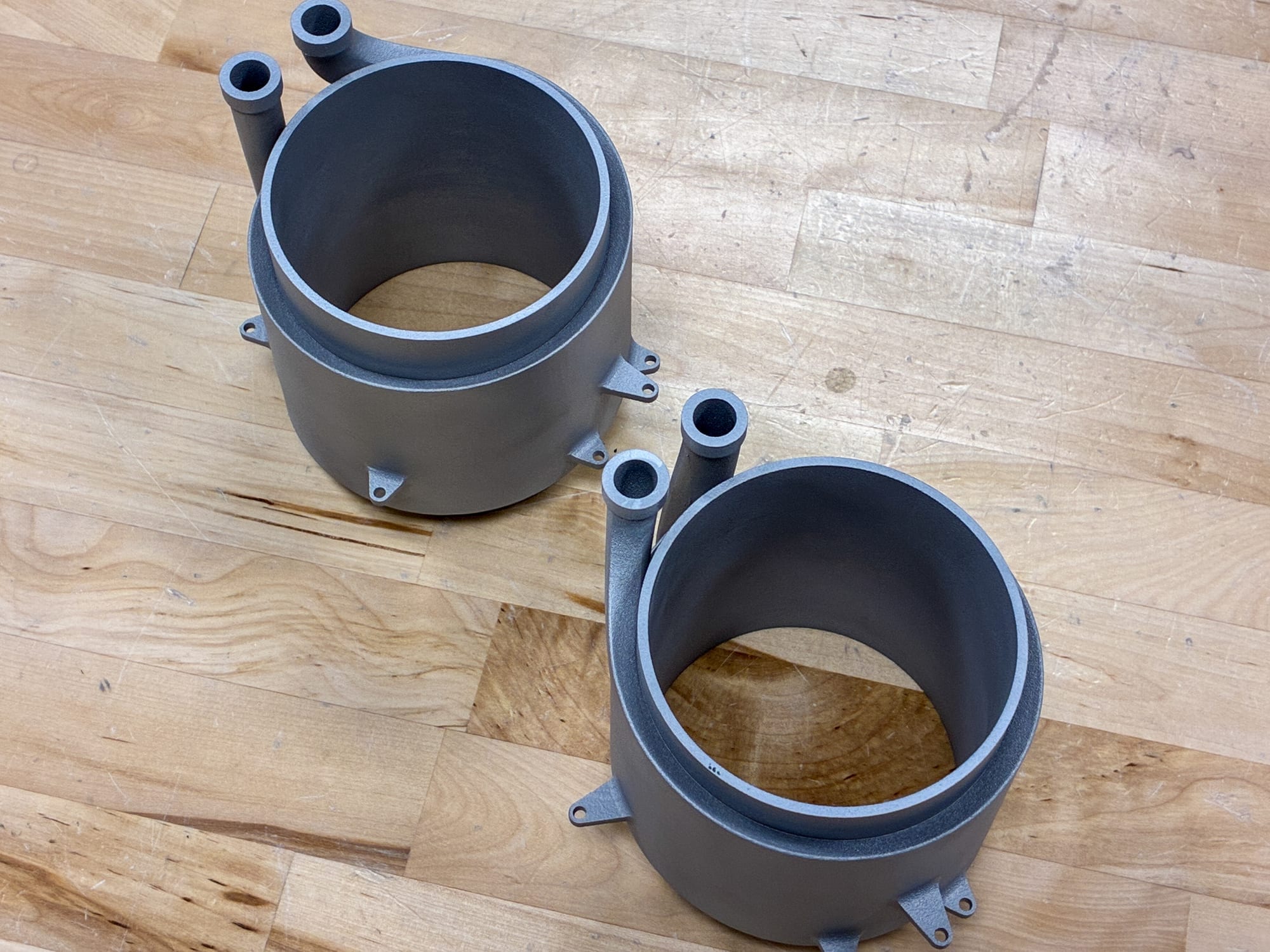
Machining the sleeve from solid would require the internal channels to be produced in multiple pieces, then welded, brazed, or otherwise joined. That adds manufacturing complexity, extra weight, and new failure points in a part designed to be as failure-proof as possible. It also limits internal geometry to what cutting tools can physically access.
Direct Metal Laser Sintering removed those constraints. Evology could produce the complex internal helical channels as a single unified component. No separate channel sections. No welded coolant passages. No need to simplify the geometry around a drill bit or end mill. The team could optimize the sleeve around system performance, including the tradeoff between heat transfer and pressure drop through the cooling circuit.
Material Selection Matters Just as Much as Geometry
The indirect sleeve also ruled out many polymer additive options. With a wall separating the motor from the flowing coolant, that wall needed to conduct heat. A low-conductivity plastic would act more like an insulator, slowing transfer from the motor housing into the coolant.
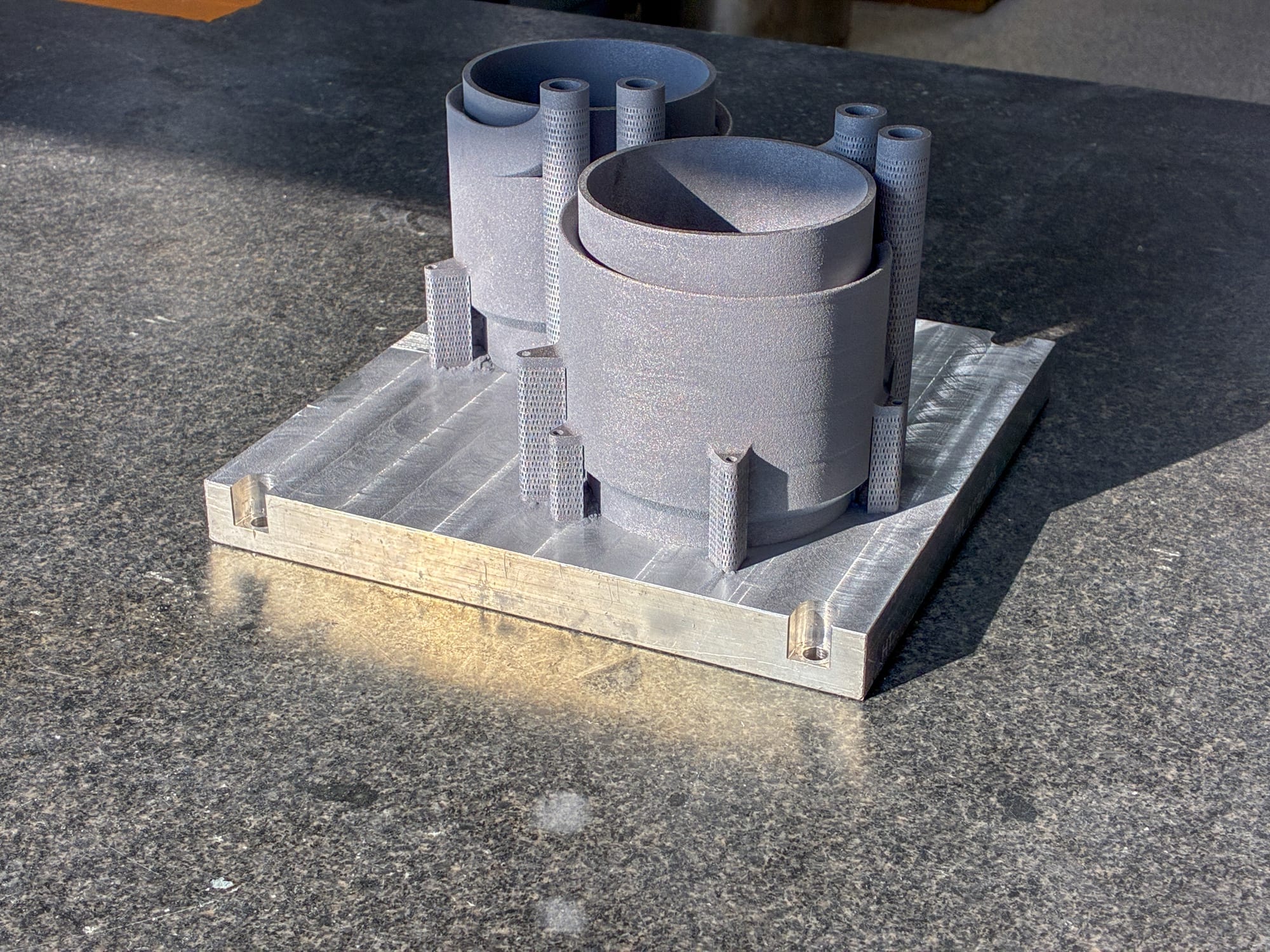
Aluminum was the better fit. DMLS aluminum conducts heat through the sleeve wall and into the water in the internal channels, while DMLS provided the geometric freedom to create those channels in the first place. Geometry and thermal performance, solved together.
Designing Around Additive Manufacturing
The cooling sleeve is an example of why design for additive manufacturing creates value beyond replacing a conventionally manufactured part. Illini was not trying to recreate a machined cooling jacket on a 3D printer. The team developed the cooling system around what the process could enable:
- A continuous internal helical coolant path
- More coolant contact with the motor housing
- Turbulence that improves convective heat transfer
- No welded or brazed internal channel assemblies
- Fewer potential coolant leak paths
- An indirect cooling architecture that stays sealed
- Aluminum to conduct heat through the sleeve wall
- A tunable tradeoff between pressure drop and cooling performance
The result is a component whose geometry, material, and manufacturing process all work around the same engineering objective.
Solving the Right Problem
One of the things we enjoy most about working with collegiate engineering teams is watching students treat manufacturing as part of the engineering process, not something that happens after the design is finished.
Illini Electric Motorsports started with the physics. How much heat is the motor generating? How efficiently can that heat move into the coolant? How do you increase heat transfer without creating excessive pressure drop? How do you keep the system sealed and reliable? Only then did manufacturing enter the conversation.
Our role was to give the team a process capable of turning that engineering into a physical component. Sometimes additive manufacturing is valuable because a part is difficult to machine. Here it was valuable because it gave the engineers freedom to design around the problem instead of around the machine.
1.02 lb
Final cooling sleeve weight
118°C
Peak winding temperature in endurance
2×
Lower convective thermal resistance
0
Motor derating events
Measured Cooling Performance
- Final sleeve weight
- 1.02 lb
- Winding temperature
- 132°C before, 118°C after implementation
- Peak winding temperature
- 118°C max during endurance testing
- Coolant temperatures
- 50°C inlet, 1.5°C delta across the sleeve
- Pressure drop
- 4 psi at 11 L/min
- Flow rate
- 11 L/min
- Vs. previous cooling solution
- 2× lower convective thermal resistance
- Motor derating
- None during testing or competition
More From the Build
Have a Thermal Management Challenge?
Complex cooling channels, lightweight structures, and internal geometries are the kinds of applications where additive manufacturing opens up new engineering options. If you are developing a heat exchanger, cold plate, cooling jacket, motor component, or another part where conventional machining is limiting the design, send us the project.
We can evaluate the geometry, material requirements, and production goals and determine whether DMLS, another additive process, or a traditional method makes the most sense. The same approach shows up across the automotive work we support.


Have a Part Like This?
Send us your files and we will scope the right process, recommend a material, and get you a quote. From a single prototype to a low-volume run, our team turns complex parts around fast.