



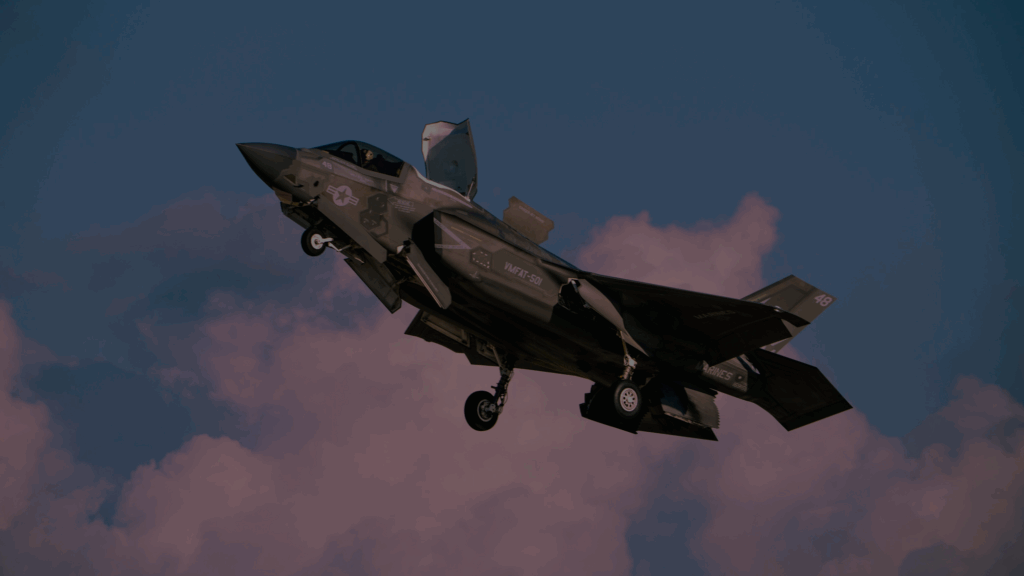





Strength to Weight
As-built parts reach 450 to 460 MPa tensile strength at about a third the density of steel. Brackets, knuckles, and housings lose real mass without giving up structure.

AlSi10Mg is the aluminum alloy we print most on our EOS DMLS systems. It is light, it carries structural loads, and its chemistry matches a common casting grade, so it can replace a cast part without a die. Heat treatment shifts its strength, ductility, and conductivity to suit the job.
Want these specifications on hand? Download the full AlSi10Mg datasheet as a PDF to share with your team or attach to a drawing package.
Download Datasheet (PDF)AlSi10Mg is aluminum with about 10% silicon and a small amount of magnesium. The silicon helps the powder melt and refreeze cleanly under the laser, which is a big part of why this alloy prints so well. The magnesium lets the metal age harden, which is what T6 heat treatment uses to adjust its properties after the build.
The powder chemistry complies with DIN EN 1706 (EN AC-43000), a casting grade many engineers already have on drawings. If your part is specified in cast AlSi10Mg, the printed version keeps the same material family.
We print it on our direct metal laser sintering systems, a process we have run in-house since 2004. If the part needs more heat or wear resistance than aluminum can give, we will point you to steel, Inconel, or titanium instead.
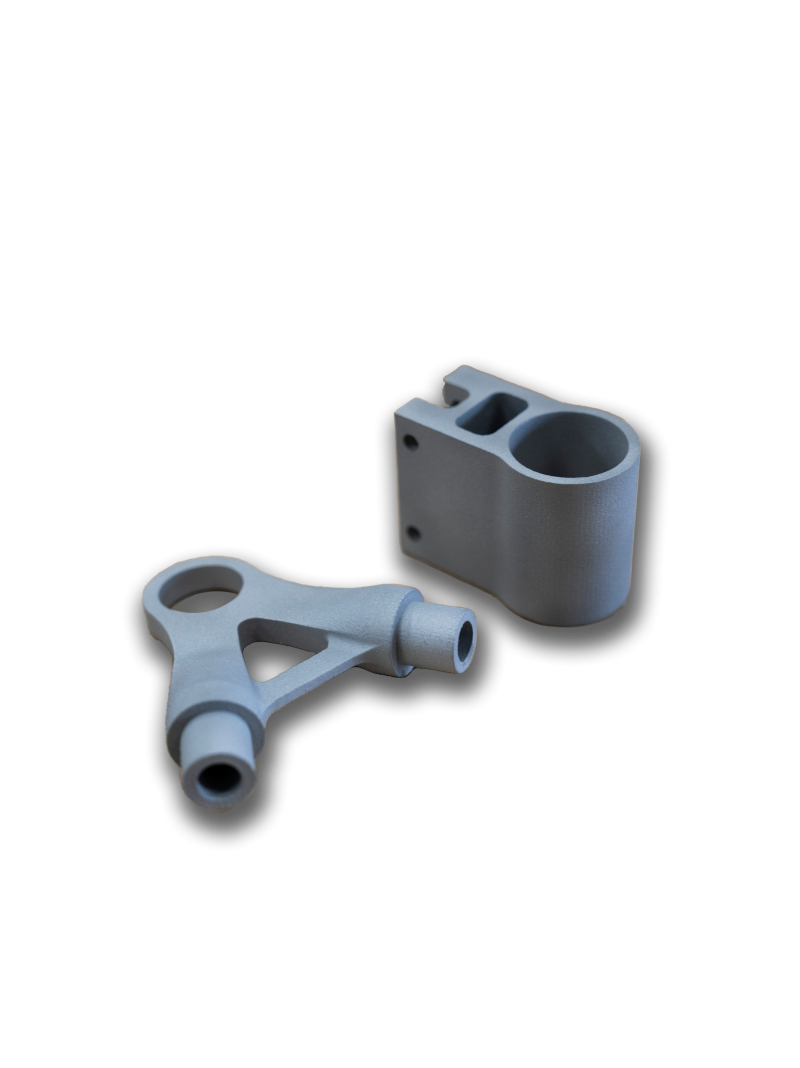
This alloy earns its place where mass, heat, and lead time matter more than raw volume.
As-built parts reach 450 to 460 MPa tensile strength at about a third the density of steel. Brackets, knuckles, and housings lose real mass without giving up structure.
The high silicon content gives the alloy good corrosion resistance in general engineering and automotive service, so many parts run bare with no coating step.
Thermal conductivity climbs from roughly 100 to 165 W/m·K after T6. Heat exchangers and cooled housings usually get heat treated for exactly that reason.
As-built material is strongest and hardest. T6 gives up some tensile strength for elongation and evens out the difference between build directions. We pick the condition from how the part is loaded.
We print AlSi10Mg for load-bearing parts, thermal hardware, and short-run work that would otherwise wait on a casting die. Most of it ships into automotive, aviation, and space programs.
Dense aluminum with internal channels that move heat efficiently, printed as one piece instead of a brazed stack of plates or tubes.
Brackets, knuckles, and housings that need stiffness and mass savings. See the Baja rear knuckle that cut weight 86% in this alloy.
Functional metal parts for motorsport, aviation, and space programs where aluminum is already the spec and DMLS removes the tooling wait.
Short-run or revised parts that would otherwise wait on a casting die. The chemistry maps to EN AC-43000, so the material family stays familiar.
The numbers below come from the EOS Aluminium AlSi10Mg material data sheet. EOS publishes validated parameter sets for several systems and layer thicknesses, and the properties differ between them, so we list each process rather than a single average. Thinner layers favor surface finish and mechanical properties. Thicker layers build faster.
| Element | Min. | Max. |
|---|---|---|
| Al | Balance | Balance |
| Si | 9.0 | 11.0 |
| Fe | — | 0.55 |
| Cu | — | 0.05 |
| Mn | — | 0.45 |
| Mg | 0.25 | 0.45 |
| Ni | — | 0.05 |
| Zn | — | 0.10 |
| Pb | — | 0.05 |
| Sn | — | 0.05 |
| Ti | — | 0.15 |
| System | Layer thickness | Build rate | Min. wall thickness | Platform temp | Inert gas |
|---|---|---|---|---|---|
| EOS M 290 | 30 µm | 5.1 mm³/s | 0.4 mm | 35 °C | Argon |
| EOS M 290 | 60 µm | 10.5 mm³/s | — | 100 °C | Argon |
| EOS M 300-4 | 60 µm | up to 4 × 10.5 mm³/s | — | 165 °C | Argon |
| EOS M 400 | 90 µm | 27.8 mm³/s | — | 165 °C | Nitrogen |
| EOS M 400-4 | 30 µm | 4 × 7.4 mm³/s | — | 165 °C | Nitrogen |
| EOS M 400-4 | 40 µm | 4 × 7.0 mm³/s | 0.3 mm | 35 °C | Argon |
| EOS M 400-4 | 80 µm | 4 × 18.1 mm³/s | 0.4 mm | 165 °C | Nitrogen |
The 30 µm M 290 process is the most fully characterized in the OEM sheet and is the source for the thermal, electrical, and gas tightness data further down. The 80 µm M 400-4 process has a published as-built surface roughness of Ra 15 µm. EOS notes that platform temperatures above 100 °C combined with high laser energy input can age the material during long builds and change its mechanical properties, especially when light supports limit heat conduction out of the part.
| Process | Orientation | Yield strength Rp0.2 [MPa] | Tensile strength Rm [MPa] | Elongation at break A [%] |
|---|---|---|---|---|
| EOS M 290, 30 µm | Vertical | 230 | 460 | 6.3 |
| EOS M 290, 30 µm | Horizontal | 270 | 450 | 10.2 |
| EOS M 290, 60 µm | Vertical | 240 | 440 | 4 |
| EOS M 290, 60 µm | Horizontal | 250 | 440 | 7 |
| EOS M 300-4, 60 µm | Vertical | 213 | 398 | 4 |
| EOS M 300-4, 60 µm | Horizontal | 228 | 377 | 7 |
| EOS M 400, 90 µm | Vertical | 240 | 380 | 2 |
| EOS M 400, 90 µm | Horizontal | 260 | 400 | 3 |
| EOS M 400-4, 30 µm | Vertical | 230 | 430 | 3 |
| EOS M 400-4, 30 µm | Horizontal | 250 | 400 | 5 |
| EOS M 400-4, 40 µm | Vertical | 230 | 450 | 5 |
| EOS M 400-4, 40 µm | Horizontal | 250 | 440 | 8 |
| EOS M 400-4, 80 µm | Vertical | 220 | 360 | 2 |
| EOS M 400-4, 80 µm | Horizontal | 250 | 380 | 2 |
Testing on machined (turned) samples. Values are averages and depend on platform temperature, job layout, and position on the build plate.
| Process | Orientation | Yield strength Rp0.2 [MPa] | Tensile strength Rm [MPa] | Elongation at break A [%] |
|---|---|---|---|---|
| EOS M 290, 30 µm | Vertical | 250 | 310 | 11 |
| EOS M 290, 30 µm | Horizontal | 260 | 320 | 11 |
| EOS M 290, 60 µm | Vertical | 250 | 320 | 8 |
| EOS M 290, 60 µm | Horizontal | 260 | 320 | 9 |
| EOS M 300-4, 60 µm | Vertical | 250 | 320 | 11 |
| EOS M 300-4, 60 µm | Horizontal | 258 | 331 | 11 |
| EOS M 400, 90 µm | Vertical | 230 | 300 | 5 |
| EOS M 400, 90 µm | Horizontal | 230 | 300 | 5 |
| EOS M 400-4, 40 µm | Vertical | 230 | 300 | 10 |
| EOS M 400-4, 40 µm | Horizontal | 250 | 300 | 10 |
| EOS M 400-4, 80 µm | Vertical | 210 | 300 | 6 |
| EOS M 400-4, 80 µm | Horizontal | 220 | 310 | 8 |
EOS has not published T6 values for the 30 µm M 400-4 process. If a build runs at elevated platform temperature, EOS strongly advises T6 afterward to bring properties back in line with the published values.
| Process | Avg. defect percentage | Density (ISO 3369) |
|---|---|---|
| EOS M 290, 30 µm | 0.04% (0.1–0.2% after T6) | ≥ 2.67 g/cm³ |
| EOS M 290, 60 µm | 0.2% | ≥ 2.66 g/cm³ |
| EOS M 300-4, 60 µm | 0.08% (max. defect size 150 µm) | — |
| EOS M 400, 90 µm | 0.2% | ≥ 2.65 g/cm³ |
| EOS M 400-4, 30 µm | 0.15% | ≥ 2.64 g/cm³ |
| EOS M 400-4, 40 µm | < 0.1% | ≥ 2.67 g/cm³ |
| EOS M 400-4, 80 µm | 0.3% | ≥ 2.65 g/cm³ |
| Orientation | As manufactured [W/m·K] | EOS T6 [W/m·K] | Stress-relieved [W/m·K] |
|---|---|---|---|
| Vertical | 100 | 165 | 160 |
| Horizontal | 110 | 155 | 165 |
| Orientation | As manufactured [% IACS] | EOS T6 [% IACS] | Stress-relieved [% IACS] |
|---|---|---|---|
| Horizontal | 25 | 44 | 44 |
| Temperature | CTE |
|---|---|
| 25–100 °C | 20×10⁻⁶/K |
| 25–200 °C | 22×10⁻⁶/K |
| 25–300 °C | 27×10⁻⁶/K |
| Property | Typical value | Method |
|---|---|---|
| Fatigue strength, lower limit (M 290, 30 µm) | 110 MPa | HCF, ASTM E466-15, 20 million cycles, fully reversed |
| Fatigue strength, lower limit (M 400-4, 40 µm) | 110 MPa | HCF, ASTM E466-15, 10 million cycles, fully reversed |
| Gas tightness, 2 mm wall (M 290, 30 µm) | 10⁻⁶ mbar l/s | Helium leak test, EN 13185:2001 |
Aluminum alloys have no true fatigue limit. Fatigue life depends on geometry and especially on surface finish. The high-cycle tests above used machined samples with no heat treatment.
Want these specifications on hand? Download the full AlSi10Mg datasheet as a PDF to share with your team or attach to a drawing package.
Download Datasheet (PDF)As-built AlSi10Mg is already strong. We add heat treatment when a part needs more elongation, more even properties between build directions, or higher conductivity.
EOS T6 is an AM-optimized cycle, about 40% shorter than a conventional T6:
The details matter. Parts go into a preheated oven, overheating stays within 5 °C, and the delay between solution annealing and quench stays under 30 seconds. Oven type and load can shift the results, so bulky or complex parts need uniform heating and cooling. A small increase in porosity after heat treatment is possible.
When parts have to come off the build plate before T6, the usual first step is a stress relief of 90 minutes at 270 °C. After stress relief alone, typical properties are about 200 MPa yield, 310 MPa tensile, and 9% elongation.
EOS recommends T6 whenever controlled mechanical properties and low scatter matter, for example after long build jobs where light supports limited heat transfer, or after a stress relief step. We will recommend a cycle once we see the geometry and how the part is used.
AlSi10Mg is aluminum with about 10% silicon and a small amount of magnesium. The silicon helps the powder melt and refreeze cleanly under the laser, so the alloy prints reliably, and the magnesium lets it respond to age hardening. Its chemistry complies with the casting grade EN AC-43000 (DIN EN 1706), which makes it a natural stand-in for cast aluminum parts.
Pick AlSi10Mg when weight, thermal conductivity, or a cast-aluminum spec drives the design. Stainless and maraging steels bring more hardness and wear resistance. Inconel holds strength at temperatures that would soften aluminum. Titanium is stronger for its weight but costs more to buy and to print. For a lightweight bracket, a heat exchanger, or a casting stand-in, AlSi10Mg is usually where we start.
Not always. As-built AlSi10Mg already has good strength and hardness. We recommend T6 when a part needs more elongation, more even properties between build directions, or higher thermal and electrical conductivity. Stress relief before cutting parts off the build plate is a separate step for geometries with high distortion risk. We recommend a cycle after we see the part and how it will be used.
DMLS tolerances can be as tight as +/- 0.005 in. (0.13 mm) in some cases. Final accuracy depends on geometry, build orientation, support strategy, and any machining after the print. Send the CAD and flag the features that have to fit, and we will tell you what the process can hold on that part.
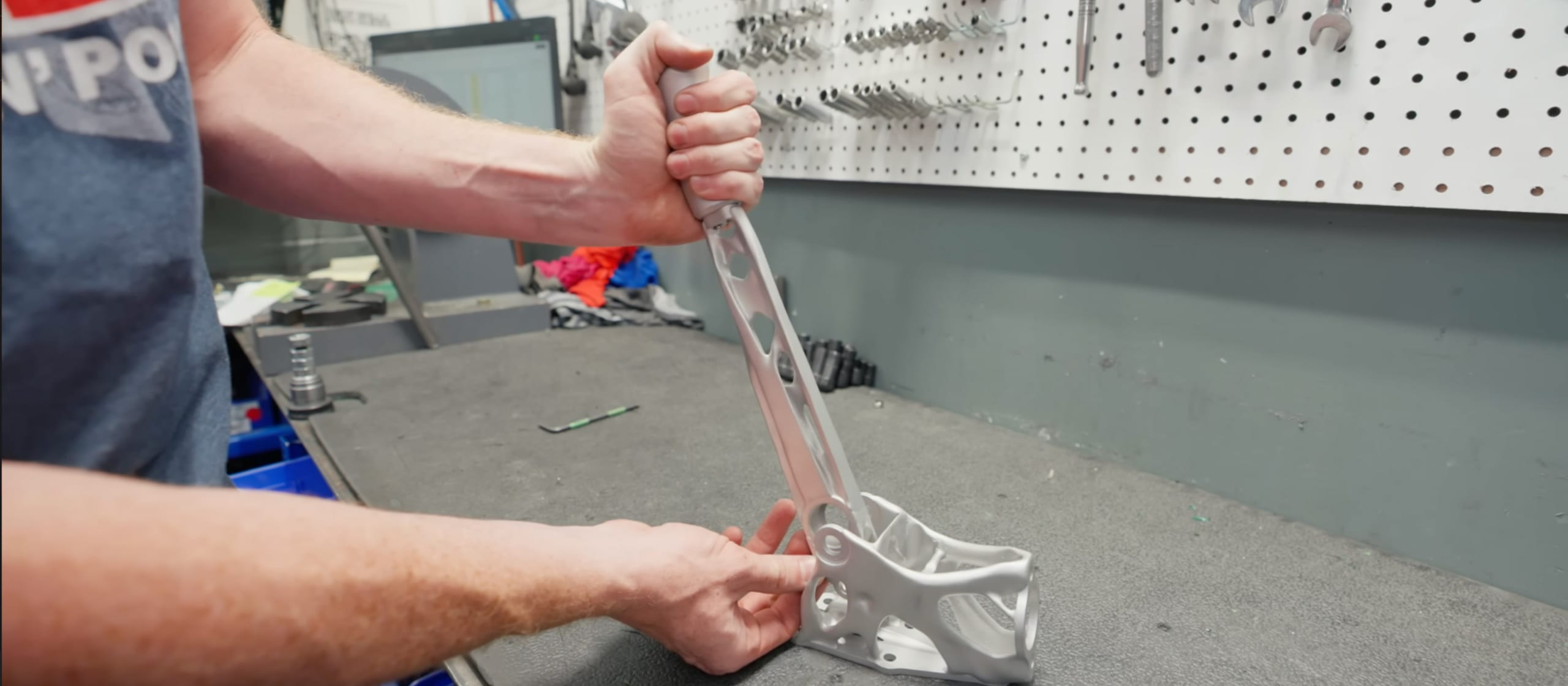
Functional metal parts that need to be light, move heat, or match a cast aluminum spec. Recent examples include a Baja rear knuckle that cut weight 86%, a structural Formula SAE oil pan, and the generatively designed handbrake and clutch pedal we printed for FDF Raceshop. Heat exchangers with internal channels and short-run casting replacements round out most of the rest.
Send us your design and one of our estimators will review it for DMLS in AlSi10Mg. We will confirm the alloy, heat treatment, tolerances, and timeline, then get you a quote.
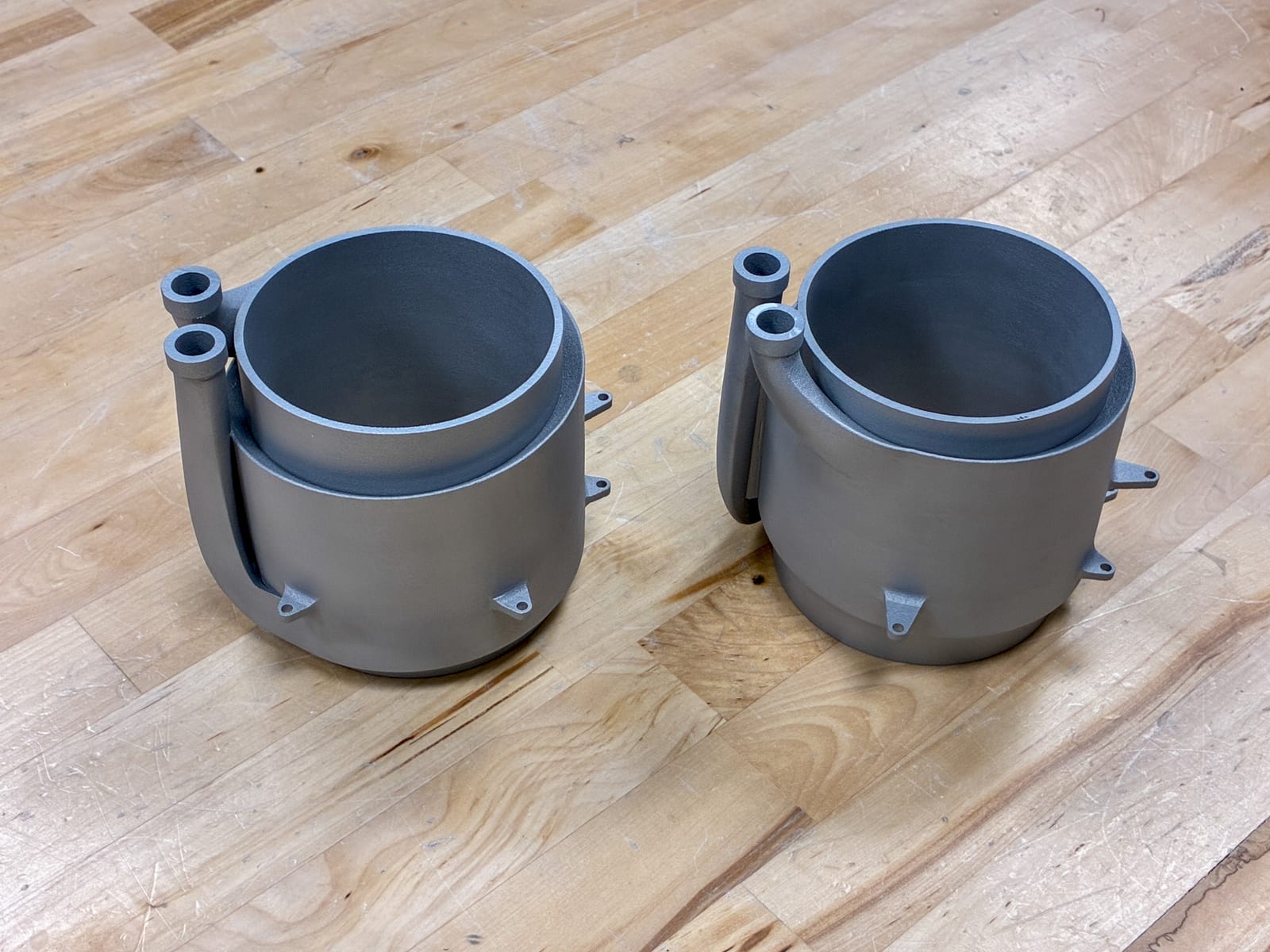
Motorsport · DMLS
Illini Electric Motorsports designed an indirect DMLS aluminum cooling sleeve with a helical coolant path to keep their AMK motors below the derating cliff. The printed geometry cut convective thermal resistance in half and eliminated derating in endurance running.
Read the Case Study →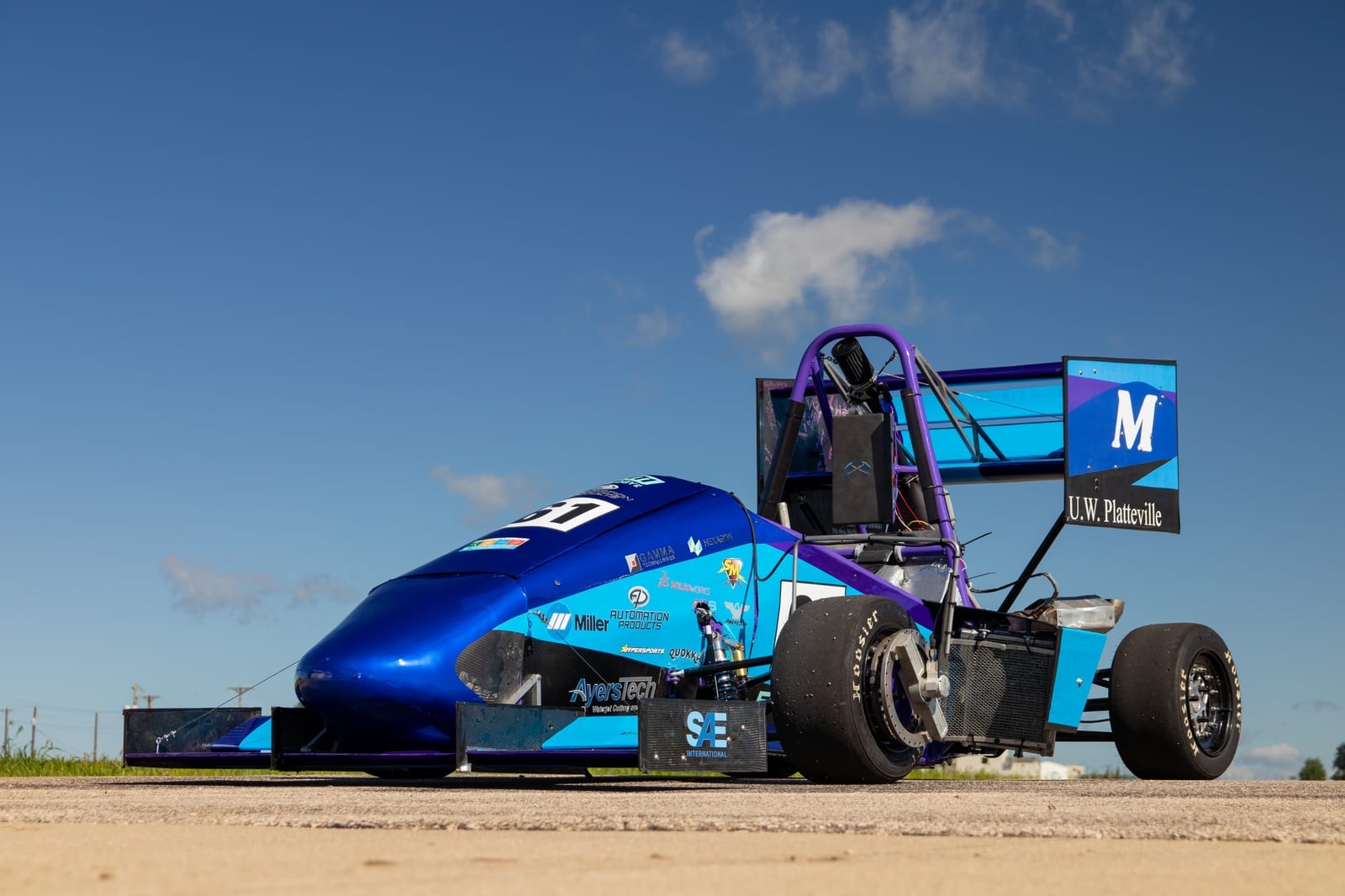
Motorsport · DMLS
Pioneer Racing designed the PR26 structural dry-sump oil pan for DMLS from the start, cutting weight 37% versus PR25 and 57% versus the original machined concept, while holding a factor of safety above five. The lighter pan helped the team to its best Formula SAE Michigan finish in program history.
Read the Case Study →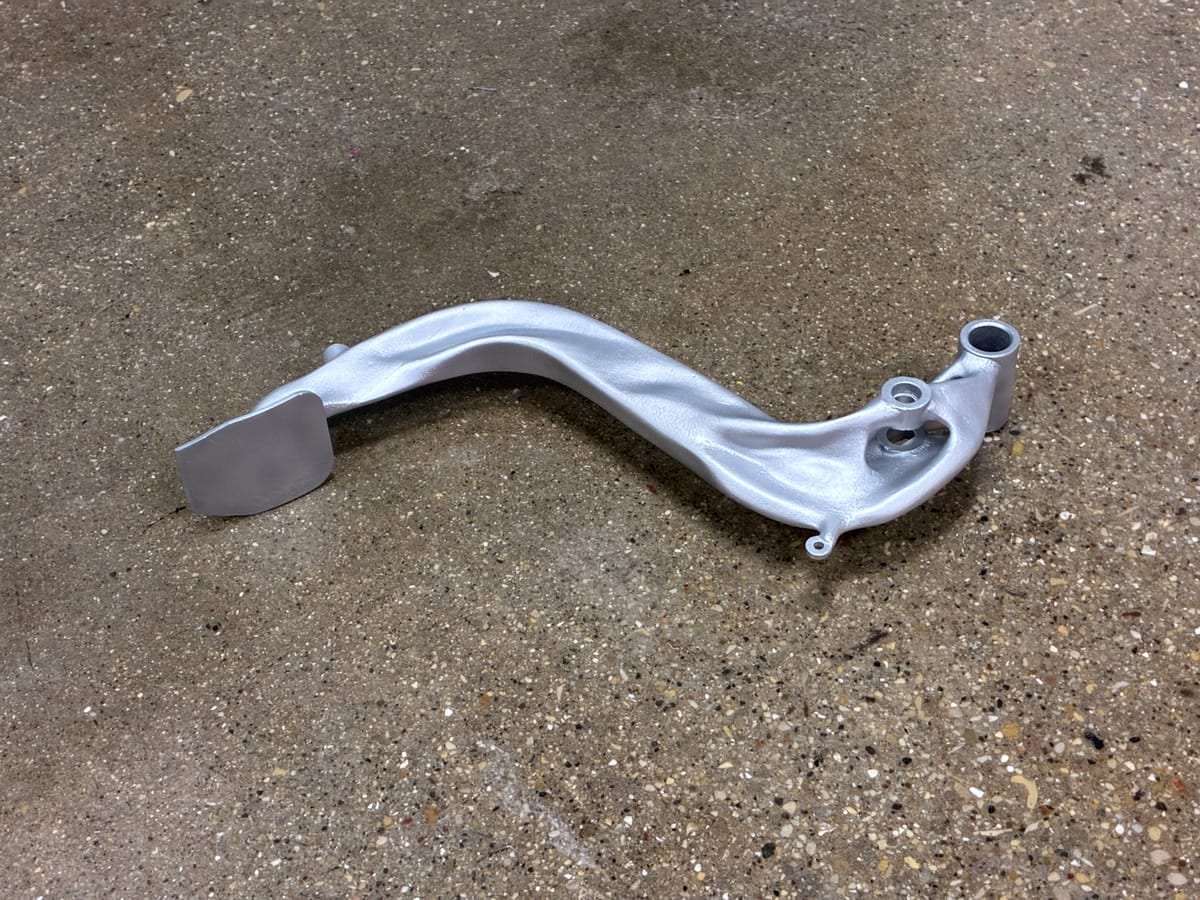
Motorsport · DMLS
Josiah Fallaise of FDF Raceshop designs his own performance parts with generative design, then needed a manufacturer who could print them in metal without cutting corners. Evology printed his hydraulic handbrake and BMW E46 clutch pedal in AlSi10Mg on an EOS M 290, North American made, structurally sound, and detailed enough to show every decision the software made.
Read the Case Study →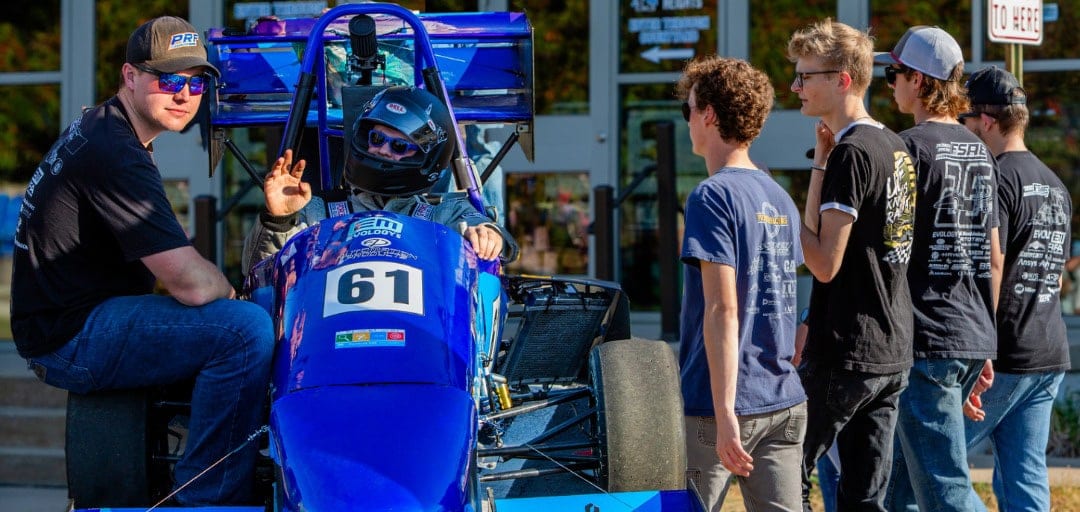
Motorsport · DMLS
For their 2024-2025 season, Pioneer Racing reimagined the PR25 powertrain as part of the chassis. The result was a DMLS oil pan that ties the engine to the rear plates, enables a dry sump system, and could not be machined conventionally.
Read the Case Study →
Motorsport · DMLS
MSOE's Raider Racing Baja team redesigned their rear suspension knuckle with DMLS. The new part cut weight, improved structural integrity, and sharpened suspension performance, all on a tight pre-race timeline.
Read the Case Study →