








Excellent Fatigue Life
Nylon 12 flexes over and over without cracking, which is why it is the go-to for snap-fit clips, closures, and living hinges. Parts that have to bend repeatedly hold up here.

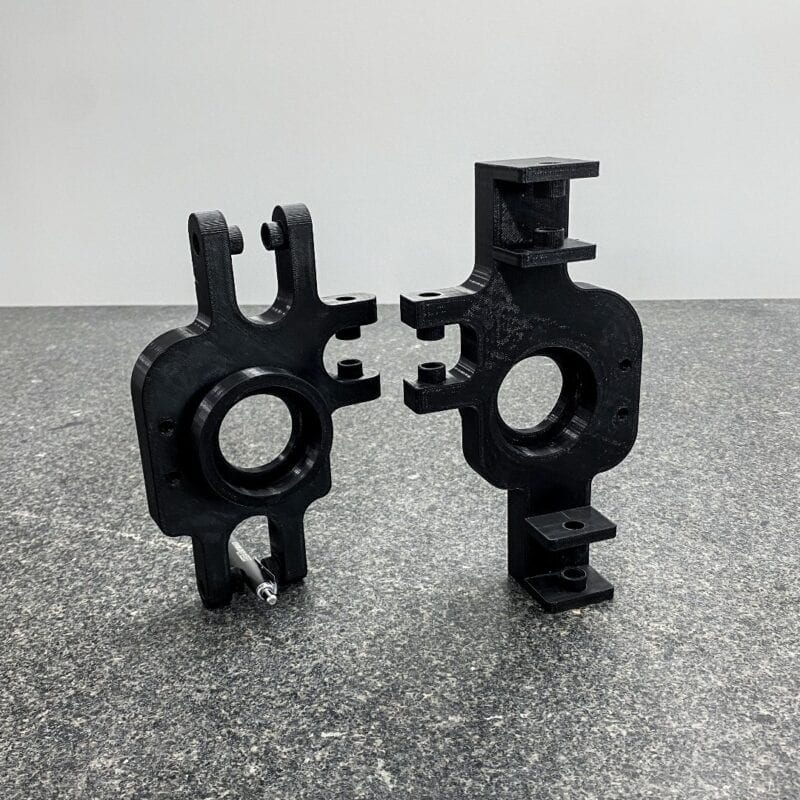
FDM Nylon 12 is the 3D-printed equivalent of industrial PA12. It is tough without being brittle and has excellent fatigue life, which makes it our pick for snap-fits, living hinges, press-fit inserts, and any part that has to flex again and again.
Want these specifications on hand? Download the full Nylon 12 datasheet as a PDF to share with your team or attach to a drawing package.
Download Datasheet (PDF)FDM Nylon 12 is a polyamide (PA12), the printed equivalent of standard industrial nylon 12. It is a strong engineering thermoplastic that stays tough without turning brittle, and its standout trait is fatigue resistance: it can flex repeatedly without cracking.
That makes it a natural fit for repetitive-flex applications like snap-fit clips, closures, and press-fit inserts. It also has high impact strength and good chemical resistance, and it stretches up to 30% before breaking in the strong orientation, so it absorbs energy instead of shattering.
We print Nylon 12 on our fused deposition modeling systems in black. Its glass transition is low, so it is chosen for toughness and flex rather than heat resistance; for high-heat parts we would point you to polycarbonate.
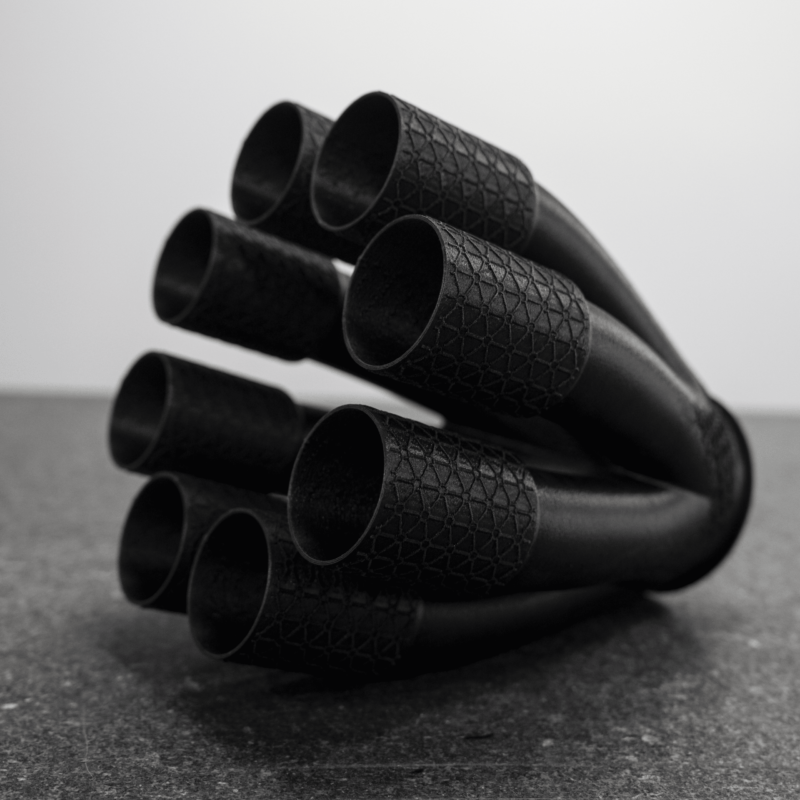
Nylon 12 earns its place when a part has to flex, take impacts, or resist chemicals that would trouble the ABS family.
Nylon 12 flexes over and over without cracking, which is why it is the go-to for snap-fit clips, closures, and living hinges. Parts that have to bend repeatedly hold up here.
It combines high impact strength with real ductility, stretching up to 30% before breaking in the strong orientation. It absorbs energy instead of shattering.
As a true PA12 polyamide, it resists many hydrocarbons, fuels, and solvents better than the ABS family, which suits under-hood and industrial parts.
Because it is the printed equivalent of standard industrial PA12, it is a reliable way to prototype nylon parts before committing to injection molding.
Nylon 12 shows up across automotive and consumer goods work, wherever parts flex, snap, or take repeated handling.
Clips, latches, and living hinges that flex repeatedly and need to survive the cycles.
Parts that rely on the material giving slightly and holding, taking advantage of nylon toughness.
Shop-floor tooling that takes repeated handling and impacts without cracking.
End-use nylon parts in modest quantities, including accurate prototypes of injection-molded PA12.
The numbers below come from the Stratasys FDM Nylon 12 material data sheet. FDM parts are anisotropic, so strength depends on orientation, and Stratasys tests more than one. We list them separately rather than quoting a single figure.
XZ (on-edge) runs the layers along the load and prints stronger and far more ductile. ZX (upright) stacks the layers across the load, so it is stiffer to break but less ductile. We orient your part to put its strength and flex where the load is. Values are typical, printed on the F900 at a 0.25 mm (0.010 in.) layer height.
| Property | Typical value | Test method |
|---|---|---|
| Specific gravity | 1.01 (at 23 °C) | ASTM D257 |
| Heat deflection (HDT) at 66 psi | 94.7 °C (202.5 °F) XY / 91.9 °C XZ/ZX | ASTM D648, Method B |
| Heat deflection (HDT) at 264 psi | 84.3 °C (183.8 °F) XY / 75.3 °C XZ/ZX | ASTM D648, Method B |
| Glass transition (Tg) | 34.0 °C (92.3 °F) | ASTM D7426 |
| Volume resistivity | > 6.87 × 10¹³ Ω·cm | ASTM D257 |
| Property | XZ orientation | ZX orientation |
|---|---|---|
| Yield strength [MPa] | 49.3 | 41.8 |
| Elongation at yield [%] | 6.1 | 5.8 |
| Strength at break [MPa] | 33.4 | 41.2 |
| Elongation at break [%] | 30 | 6.5 |
| Tensile modulus [GPa] | 1.51 | 1.25 |
Nylon 12 yields before it breaks in both orientations, and the high elongation in XZ (30%) is what gives it its flex and toughness.
| Property | XZ orientation | ZX orientation |
|---|---|---|
| Strength at break [MPa] | No break | No break |
| Strength at 5% strain [MPa] | 56.5 | 54.5 |
| Flexural modulus [GPa] | 1.26 | 1.20 |
"No break" means the bars flexed without fracturing, so Stratasys reports strength at 5% strain instead.
| Property | XZ orientation | ZX orientation |
|---|---|---|
| Compressive yield strength [MPa] | 327 | 557 |
| Compressive modulus [GPa] | 1.48 | 1.65 |
| Izod impact, notched [J/m] | 138 | 71.0 |
| Izod impact, unnotched [J/m] | 1800 | 322 |
Compression per ASTM D695, Izod impact per ASTM D256. Like most nylons, Nylon 12 densifies under compression rather than fracturing, so the reported compressive values are high.
Want these specifications on hand? Download the full Nylon 12 datasheet as a PDF to share with your team or attach to a drawing package.
Download Datasheet (PDF)A few things worth knowing before you send a Nylon 12 part. Orientation and moisture are the big ones.
Orientation drives strength and flex. A part is strongest and most ductile along its layers, so for snap-fits and hinges we point the layers along the bending direction to make the most of the fatigue life. If a feature has to flex in every direction, tell us and we will plan for it.
Nylons absorb moisture from the air, which can affect dimensions and properties over time. We handle and store the filament dry, and for parts with tight tolerances we account for it. If your part will live in a humid or wet environment, let us know.
Finishing works, with a caveat. Nylon 12 can be sanded and machined, but its surface does not take paint and adhesives as readily as ABS. Soluble support washes out of internal channels and pockets, so enclosed features are on the table.
Fatigue resistance. Nylon 12 can flex over and over without cracking, and it stretches up to 30% before breaking in the strong orientation. That combination lets snap-fit clips, closures, and living hinges survive repeated cycles that would fatigue and crack stiffer plastics like ABS.
FDM Nylon 12 is the printed equivalent of standard industrial PA12, so it behaves much like molded nylon 12 and is a reliable way to prototype those parts before tooling. Because it is printed, it is anisotropic (strength depends on orientation), which molded parts are not, so we orient the build to match how the part is loaded.
Not especially. Its glass transition is low (around 34 °C) and heat deflection is near 84 °C at 264 psi, so it is chosen for toughness and flex rather than heat. If your part sees sustained warmth, polycarbonate or Nylon 12CF is a better fit.
Yes, like all nylons it takes on moisture from the air, which can shift dimensions and properties over time. We store and handle the filament dry and account for it on tight-tolerance parts. If your part will live in a humid or wet environment, tell us so we can plan for it.
As a PA12 polyamide, it resists many hydrocarbons, fuels, and solvents better than the ABS family, which makes it useful for under-hood and industrial parts. If your part will contact a specific chemical, let us know and we will confirm compatibility.
It can be sanded and machined, but its surface does not take paint and adhesives as readily as ABS, which is common for nylons. Soluble support washes out of internal channels, so enclosed features are possible. If a specific finish is required, tell us and we will confirm the approach.
Send us your design and one of our estimators will review it for FDM in Nylon 12. We will confirm the material, orientation, and timeline, then get you a quote.