






Strength Without Fillers
Unfilled Nylon 12 carries structural loads and still flexes enough for hinges and snap features. No glass or carbon needed for most general-purpose parts.

PA12 is unfilled Nylon 12 for SLS. It is strong enough for functional parts, tough enough for hinges and snaps, and we print it on our EOS P 396 and EOS P 770 for prototypes and short-run production.
Want these specifications on hand? Download the full PA12 datasheet as a PDF to share with your team or attach to a drawing package.
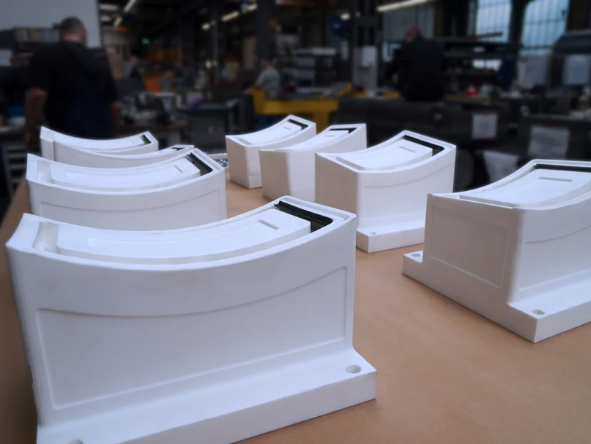
Download Datasheet (PDF)PA12 is polyamide 12 without glass or carbon fill. The white powder sinters into white parts that hold load and still stretch enough for hinges, threads, and snap-fits. For general-purpose SLS nylon, this is the grade we reach for first.
The powder around the part supports it during the build, so there is nothing to cut away afterward. Internal channels, undercuts, and nested packs of small parts come at no extra support cost.
We print it on our selective laser sintering systems, the EOS P 396 and EOS P 770. If you need more stiffness than unfilled nylon can give, we will point you to PA12 GF or carbon-filled nylon instead.
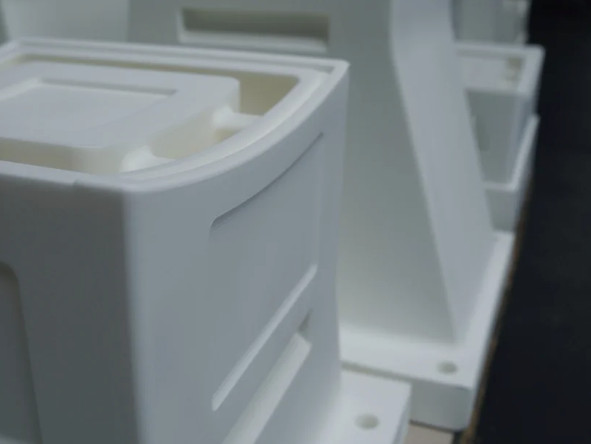
Use it when you want straight Nylon 12 properties and the geometry would make tooling or machining slow or expensive.
Unfilled Nylon 12 carries structural loads and still flexes enough for hinges and snap features. No glass or carbon needed for most general-purpose parts.
Loose powder holds the part up as it builds, so internal channels and undercuts come off the machine clean. No support structures to cut away.
Unfilled PA12 is the default SLS nylon most shops already know. If your drawing calls for Nylon 12, this is usually where we start.
Some commercial unfilled PA12 SLS powders document EU food-contact compliance under OEM data-sheet conditions. Tell us the end use and we will confirm what that means for your part.
Most of our PA12 work ships into automotive, consumer goods, and medical programs.
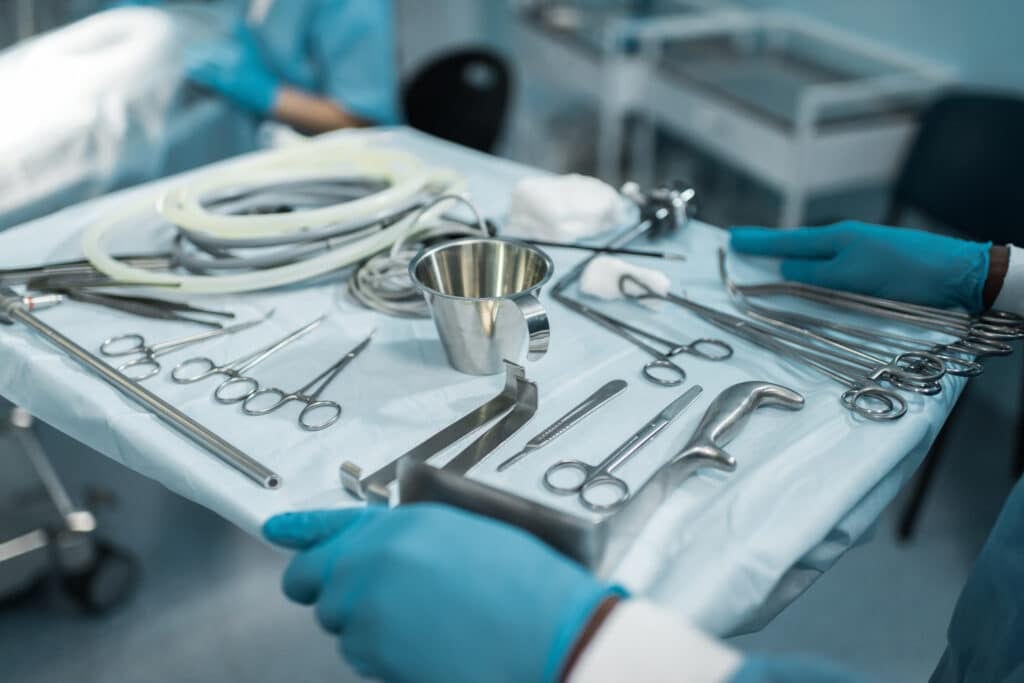
Shop-floor tooling that needs nylon toughness without waiting on machining or molding.
Enclosures and spare parts for automotive, industrial, and consumer work specified in unfilled PA12.
Parts that need elongation for living hinges, snaps, or printed threads before you cut tooling.
Cutting guides, bone models, eyewear, and other white nylon parts where detail and finish matter.
The numbers below are representative unfilled PA12 SLS values from the EOS PA 2200 Material Data Sheet for the Balance parameter set (120 µm). EOS also publishes a Performance set at 100 µm with higher strength and more isotropic fracture behavior. Values are dry-condition typicals and vary with orientation and powder grade.
| Parameter set | Layer | Tensile modulus [MPa] | Tensile strength [MPa] | Strain at break |
|---|---|---|---|---|
| Balance | 120 µm | 1650 (X/Y/Z) | 48 (X/Y), 42 (Z) | 18% (X/Y), 4% (Z) |
| Performance | 100 µm | 1700 (X/Y/Z) | 50 (X/Y/Z) | 20% (X/Y), 10% (Z) |
Balance (120 µm) trades production cost, surface quality, and accuracy for general-purpose parts. Performance (100 µm) favors mechanical properties and isotropic strength under multiaxial loads. Tensile values per ISO 527-1/-2, dry condition.
| Property | X | Y | Z | Test |
|---|---|---|---|---|
| Tensile modulus [MPa] | 1650 | 1650 | 1650 | ISO 527-1/-2 |
| Tensile strength [MPa] | 48 | 48 | 42 | ISO 527-1/-2 |
| Strain at break [%] | 18 | 18 | 4 | ISO 527-1/-2 |
| Flexural modulus [MPa] | 1500 | — | — | ISO 178 |
| Shore D hardness | 75 | — | — | ISO 7619-1 |
X and Y are in-plane build orientations; Z is through-thickness. Flexural modulus and Shore D are published for the X orientation only.
| Property | Typical value | Test |
|---|---|---|
| Charpy impact strength (+23 °C) [kJ/m²] | 53 | ISO 179/1eU |
| Charpy notched impact (−30 °C) [kJ/m²] | 4.8 | ISO 179/1eA |
| Izod notched impact (+23 °C) [kJ/m²] | 4.4 | ISO 180/1A |
| Property | X | Z | Test |
|---|---|---|---|
| Melting temperature [°C] | 176 | — | ISO 11357-1/-3 |
| HDT at 1.80 MPa [°C] | 64 | 57 | ISO 75-1/-2 |
| HDT at 0.45 MPa [°C] | 157 | 145 | ISO 75-1/-2 |
| Vicat softening temperature [°C] | 176 | — | ISO 306/B50 |
| Burning behavior (UL 94) | HB | — | 0.5–3.2 mm |
UL 94 HB passed at 0.5 mm, 1.6 mm, and 3.2 mm thickness per the EOS Process Data Sheet.
| Property | Typical value | Method |
|---|---|---|
| Density | 0.93 g/cm³ | EOS Method |
| Powder color | White | — |
| Component color | White | — |
Want these specifications on hand? Download the full PA12 datasheet as a PDF to share with your team or attach to a drawing package.
Download Datasheet (PDF)Unfilled polyamide 12 (Nylon 12) for selective laser sintering. It prints as white parts that are strong enough for functional use and ductile enough for hinges, threads, and snap features. We run it on our EOS P 396 and EOS P 770.
Choose PA12 when you want plain Nylon 12 with good elongation. Glass-filled PA12 GF is stiffer and holds dimensions better when rigidity matters more than flex. Carbon-filled nylon bumps modulus further and prints darker. Send the geometry and loads and we will pick a grade.
Some commercial unfilled PA12 SLS powders document EU food-contact compliance under conditions in the OEM data sheet (for example EOS PA 2200). Medical biocompatibility depends on the finished part, cleaning, and your regulatory path. Tell us the end use and we will scope what is needed.
Accuracy depends on geometry, orientation, powder condition, and finishing. Typical SLS parts hold about ±0.3% of a dimension, with a floor near ±0.3 mm on small features. Flag the fits on the drawing and we will tell you what we can hold.
Housings, covers, jigs, fixtures, brackets, consumer parts, and prototypes with living hinges or threads. The powder bed supports the build, so complex internals do not need support structures.
Send the CAD and we will review it for SLS in PA12, confirm orientation and timeline, and get you a quote.