






High Stiffness
Glass beads push tensile modulus to about 3200 MPa in X/Y, roughly double unfilled PA12. Housings and brackets hold shape under load.

PA12 GF is Nylon 12 filled with about 40 wt% glass beads. It is stiffer and more wear-resistant than unfilled PA12, which suits housings under load, abrasion-prone parts, and forming tools on our EOS P 396 and EOS P 770.
Want these specifications on hand? Download the full PA12 GF datasheet as a PDF to share with your team or attach to a drawing package.
Download Datasheet (PDF)PA12 GF is polyamide 12 powder with about 40 wt% glass beads. Parts come out whitish and noticeably stiffer than PA12. The fill also helps with wear and heat deflection under load.
Elongation is lower than unfilled nylon, so this is not the grade for living hinges or soft snaps. Use it when the part has to resist bending, abrasion, or warmth under load.
We print it on our selective laser sintering systems, the EOS P 396 and EOS P 770. If you need more flex than glass-filled nylon allows, we will point you back to PA12.
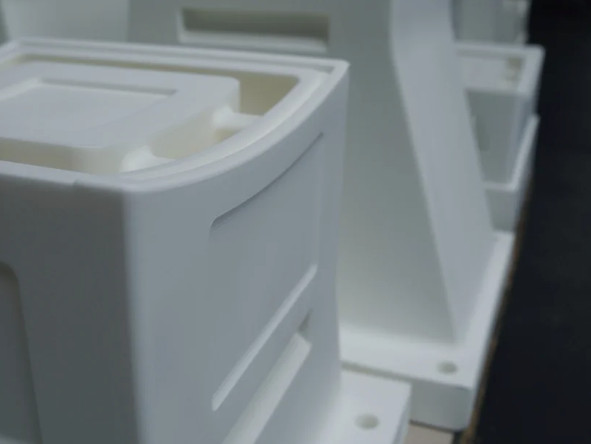
Use it when unfilled Nylon 12 is too soft under load or wears too quickly in service.
Glass beads push tensile modulus to about 3200 MPa in X/Y, roughly double unfilled PA12. Housings and brackets hold shape under load.
The glass fill helps parts that slide, rub, or see repeated contact hold up longer than plain Nylon 12.
HDT at 1.80 MPa is 96 °C in X, well above unfilled PA12 Balance. Useful when the part sees warmth under load.
Same SLS powder-bed process as PA12. Internal features and nested builds come off without support removal.
Most of our glass-filled SLS work ships into automotive and consumer goods programs where housings and fixtures take real load.
Enclosures and structural covers that need stiffness under load, not just nylon toughness.
Guides, covers, and fixtures that see abrasion or repeated contact on the shop floor.
Short-run tools that benefit from glass-filled rigidity without cutting steel tooling.
Jigs and brackets where deflection under clamp or service loads would be a problem in unfilled nylon.
The numbers below are representative glass-filled PA12 SLS values from the EOS PA 3200 GF Material Data Sheet. Values are dry-condition typicals and vary with orientation and powder grade.
| Property | X | Y | Z | Test |
|---|---|---|---|---|
| Tensile modulus [MPa] | 3200 | 3200 | 2500 | ISO 527-1/-2 |
| Tensile strength [MPa] | 51 | 51 | 47 | ISO 527-1/-2 |
| Strain at break [%] | 9 | 9 | 5.5 | ISO 527-1/-2 |
| Flexural modulus [MPa] | 2900 | — | — | ISO 178 |
| Flexural strength [MPa] | 73 | — | — | ISO 178 |
| Shore D hardness | 80 | — | — | ISO 7619-1 |
| Ball indentation hardness [MPa] | 98 | — | — | ISO 2039-1 |
X and Y are in-plane build orientations; Z is through-thickness. Flexural, hardness, and Shore D values are published for the X orientation only.
| Property | Typical value | Test |
|---|---|---|
| Charpy impact strength (+23 °C) [kJ/m²] | 35 | ISO 179 |
| Charpy notched impact (+23 °C) [kJ/m²] | 5.4 | ISO 179 |
| Izod impact strength (+23 °C) [kJ/m²] | 21 | ISO 179 |
| Izod notched impact (+23 °C) [kJ/m²] | 4.2 | ISO 179 |
Test standards are those listed on the EOS Material Data Sheet.
| Property | Typical value | Test |
|---|---|---|
| HDT at 1.80 MPa [°C] | 96 | ISO 75-1/-2 |
| HDT at 0.45 MPa [°C] | 157 | ISO 75-1/-2 |
The cited EOS PA 3200 GF Material Data Sheet does not publish a melting temperature value.
| Property | Typical value | Method |
|---|---|---|
| Density | 1.22 g/cm³ | EOS Method |
| Powder color | Whitish | — |
| Component color | Whitish | — |
| Glass bead fill | 40 wt% | — |
Want these specifications on hand? Download the full PA12 GF datasheet as a PDF to share with your team or attach to a drawing package.
Download Datasheet (PDF)Nylon 12 filled with glass beads for SLS (about 40 wt% on typical commercial grades). Parts are stiffer and more wear-resistant than unfilled PA12, with better heat deflection under load. We print it on our EOS P 396 and EOS P 770.
Choose PA12 GF when the part needs higher stiffness, better abrasion resistance, or higher HDT under load. Stick with PA12 when you need more elongation for hinges, snaps, or living hinges. Send the geometry and loads and we will pick a grade.
Representative OEM data puts tensile modulus around 3200 MPa in X/Y for glass-filled PA12 versus about 1650 MPa for unfilled PA12 Balance. Flexural modulus is about 2900 MPa versus 1500 MPa. That gain comes with less strain at break (about 9% in X/Y versus 18%).
Accuracy depends on geometry, orientation, powder condition, and finishing. Typical SLS parts hold about ±0.3% of a dimension, with a floor near ±0.3 mm on small features. Flag the fits on the drawing and we will tell you what we can hold.
Housings and machine components under load, abrasion-prone covers and guides, and forming tools. Glass fill adds stiffness and wear resistance that unfilled nylon does not have.
Send the CAD and we will review it for SLS in PA12 GF, confirm orientation and timeline, and get you a quote.